Few phrases in the Apostle Paul’s letters have sparked as much debate, speculation, and theological wrestling as the famous statement in Romans 11:26. When you read the words, “And so all Israel will be saved,” it is easy to wonder exactly what Paul meant. Does this promise a future national revival? Does it imply a separate path to salvation based on ethnicity? Or does it point to something far more profound about God’s covenant and His unified people?
Many readers lift this single verse out of its rich context. They force it to carry ideas Paul never intended, such as nationalistic triumphalism, a two-track salvation system, or a future redemption entirely apart from Jesus Christ. However, when you read Romans 11 carefully, contextually, and historically, Paul’s meaning becomes incredibly coherent. More importantly, it remains entirely faithful to the gospel message he preaches everywhere else in his letters.
In this comprehensive guide, we will explore exactly what “And so all Israel will be saved” means. We will look at the grammar, the historical context, the olive tree metaphor, and the incredible mystery of God’s mercy.
Key Takeaways from This Article:
- Why the phrase “and so” is critical to understanding Paul’s method of salvation.
- How the metaphor of the olive tree explains the inclusion of Gentiles and the restoration of the Jews.
- The three historic views of “all Israel” and which one aligns with the rest of Scripture.
- Why God defines His covenant people by promise and faith, rather than mere physical descent.
- Answers to the most frequently asked questions about this complex theological topic.
The Crucial Context of “And So All Israel Will Be Saved”
To grasp the true meaning of “And so all Israel will be saved,” we must first look at the exact words Paul uses. Context is everything in biblical literature.
Start With the Phrase “And So”
Notice carefully that Paul does not say, “and then all Israel will be saved.” He says, “and so.” In the original Greek language, the word used is houtōs. This distinction matters immensely.
The phrase “and so” means “in this manner” or “in this way.” Paul is not primarily pointing to a timeline or a chronological sequence of events. Instead, he is pointing to a method. He is explaining how God will accomplish this salvation, rather than simply stating when it will happen.
So, the fundamental question we must ask is: In what exact way does Paul say “and so all Israel will be saved”? To find the answer, we only need to look at the verses immediately preceding Romans 11:26.
The Method Paul Describes (Romans 11:17–25)
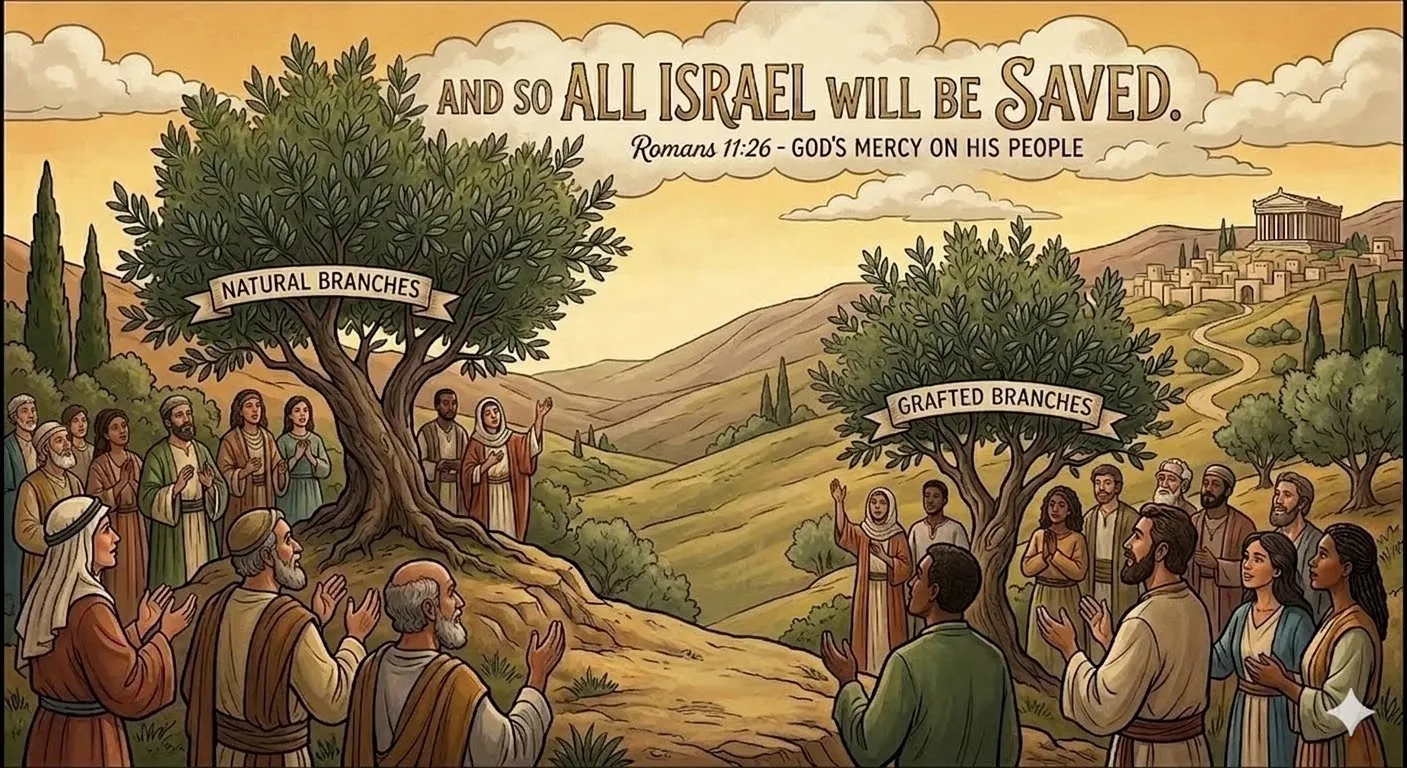
In the verses leading up to our key phrase, Paul explains a specific spiritual process using the powerful metaphor of an olive tree. Here is the step-by-step method Paul outlines:
- A Partial Hardening: Israel experiences a temporary, partial hardening of their hearts toward the gospel.
- Gentiles Grafted In: Because of this stumbling, the gospel goes out to the Gentiles. Non-Jewish believers are grafted into the olive tree by faith.
- Provoking Jealousy: The inclusion and blessing of the Gentiles are meant to provoke ethnic Israel to jealousy.
- Grafted Back In: Jewish people who turn to Christ are grafted back into their own natural olive tree, provided they do not persist in unbelief.
This process clearly shows that this is not a mass, automatic conversion apart from Christ. It is not salvation granted merely by ethnicity or bloodline. Instead, it is salvation by faith, through the exact same olive tree.
Paul is explicit in Romans 11:23: “And even they, if they do not continue in their unbelief, will be grafted in, for God has the power to graft them in again.”
There is only one tree, not two separate trees for Jews and Gentiles. There is one root, not two distinct covenants. There is only one means of salvation: faith in Jesus Christ. “And so all Israel will be saved” by this exact method of Jews and Gentiles coming together through faith.
What Exactly Does “All Israel” Mean?
Throughout Church history, theologians have debated the identity of “all Israel.” Generally, there have been three main interpretations. However, when you look closely at Paul’s broader theology, only one option truly fits his argument without creating massive contradictions.
Comparing the Three Views of “All Israel”
Here is a simple table breaking down the three primary views of who “all Israel” represents:
| Interpretation | Description | Does it fit Paul’s Theology? |
|---|---|---|
| Option 1: Every Ethnic Jew | The belief that every single ethnic Jew throughout history, or alive at the end of time, will be saved regardless of personal faith. | ❌ No. Fails immediately. Paul states not all descended from Israel are Israel (Rom. 9:6). Salvation requires faith. |
| Option 2: Future National Salvation | The idea that ethnic Israel has a distinct future destiny separate from the Church, saved apart from the standard gospel message. | ❌ No. Creates two peoples of God and two covenant destinies, which Paul rejects in Romans and Galatians. |
| Option 3: The Full Covenant People | “All Israel” represents the complete number of God’s elect-both Jews and Gentiles united in Christ, forming the full olive tree. | ✅ Yes. This historic view perfectly aligns with Romans 9–11, Galatians 3, and Ephesians 2. |
Why Option 3 is the Correct View
When Paul writes, “And so all Israel will be saved,” he is referring to the full covenant people of God. This includes the complete number of elect Jews and the full number of elect Gentiles united as one body in Christ. It represents the completion of the olive tree and the ultimate fulfillment of God’s ancient promises to Abraham.
This interpretation beautifully aligns with the theology of the early Church. It also matches Paul’s arguments in Galatians 3 and Ephesians 2, where he insists that Jesus Christ has broken down the dividing wall of hostility, creating one new humanity out of the two.
Israel Defined by Promise, Not Flesh
To understand how “And so all Israel will be saved,” we must let Paul define his own terms. Earlier in the book of Romans, Paul makes a radical statement that redefines how we should view Israel.
In Romans 9:6, he writes, “For not all who are descended from Israel belong to Israel.”
He echoes this same foundational truth in his letter to the Galatians: “And if you are Christ’s, then you are Abraham’s offspring, heirs according to promise” (Galatians 3:29).
Paul is not inventing a brand new religion. He is not introducing a strange, novel concept. He is simply reading the Old Testament through the lens of Jesus Christ. This is exactly what Jesus taught His apostles to do on the road to Emmaus in Luke 24.
Historically and biblically, true Israel has always been defined by three things:
- The Promise of God: Salvation rests on God’s sworn word, not human effort.
- Faith: Trusting in the Messiah has always been the requirement for righteousness.
- God’s Calling: Being part of God’s family is a result of divine election, not mere physical ethnicity.
Therefore, when we read “And so all Israel will be saved,” we must view “Israel” through this spiritual, promise-driven lens.
The Old Testament Foundation
Paul does not make his claims in a vacuum. To prove his point that “And so all Israel will be saved,” he immediately quotes the Old Testament prophet Isaiah in Romans 11:26-27:
“The Deliverer will come from Zion, he will banish ungodliness from Jacob; and this will be my covenant with them when I take away their sins.”
Notice very carefully what Paul chooses to highlight-and what he leaves out.
- He does not mention the restoration of physical land in the Middle East.
- He does not mention political sovereignty or a renewed earthly kingdom.
- He does not mention the rebuilding of a physical temple or a return to animal sacrifices.
Instead, he focuses entirely on deliverance from sin. He highlights ungodliness being banished. This is covenant salvation language, pure and simple. It is not about a geopolitical fulfillment; it is about spiritual redemption. The Deliverer, Jesus Christ, comes to deal with the root problem of humanity: sin.
Revealing the Mystery in Romans 11
In Romans 11:25, right before he declares, “And so all Israel will be saved,” Paul uses a fascinating word. He calls this entire process a “mystery.”
In the New Testament, a mystery is not a puzzle meant to confuse us, nor is it something unknowable. A biblical mystery is a truth that was previously hidden but has now been openly revealed by God.
Why does Paul call this a mystery?
- First century Jews expected Gentiles to come to God by submitting to the Mosaic Law and becoming Jewish proselytes.
- Instead, God reveals that Gentiles are coming directly into the covenant family through faith in Christ alone.
- Furthermore, Israel’s tragic stumbling actually becomes the very mechanism God uses to bring global mercy to the nations.
The mystery is not that ethnic Israel will have future political dominance. The mystery is God’s stunning, unexpected, and boundary-breaking mercy. God uses the rejection of the Messiah by the majority of Jews to open the doors of grace to the entire world. Then, He uses the salvation of the world to draw Jewish people back to their true Messiah.
When Paul contemplates this incredible plan, his response is not to draw up complex prophecy charts. His response is pure worship. He bursts into praise in Romans 11:33: “Oh, the depth of the riches and wisdom and knowledge of God! How unsearchable are his judgments and how inscrutable his ways!”
Why Dispensational Views Miss the Mark
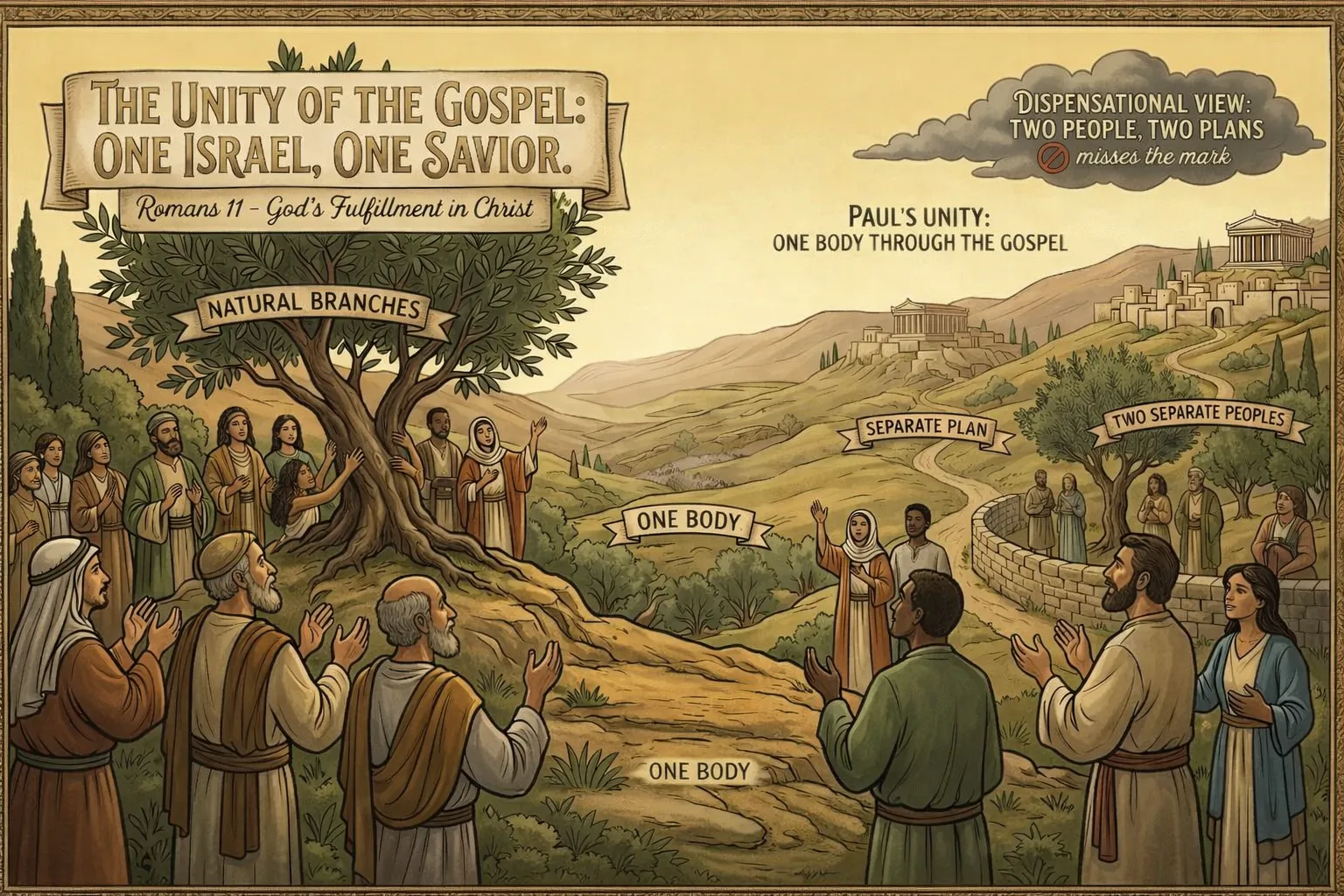
In modern times, a theological system known as dispensationalism has become popular. This view often reads Romans 11 backward. It begins with a preconceived theory about a future, physical earthly kingdom for ethnic Jews, and then it forces the text of Romans to fit that theory.
Paul does the exact opposite.
- He begins with Jesus Christ.
- He explains all of human history through the lens of the gospel.
- He defends God’s faithfulness to His Old Testament promises without redefining what salvation actually means.
Dispensational readings often claim that God has two separate peoples: the Church (Gentiles) and Israel (Jews), with two different plans and destinies. But this shatters the unity of the gospel Paul preached. Paul never attempts to comfort ethnic Israel by promising them a separate future apart from the Church. He comforts them by insisting that God has not abandoned His covenant, and that this covenant is gloriously fulfilled in only one way: through Jesus Christ.
When Paul says, “And so all Israel will be saved,” he is protecting the unity of the church. He is declaring that there is no alternative route to God.
One Mercy, One Savior, One People
Paul summarizes and concludes this entire magnificent section of his letter with a sweeping, universal statement in Romans 11:32:
“For God has consigned all to disobedience, that he may have mercy on all.”
That single sentence completely destroys any notion of ethnic privilege before God. It eliminates the idea of a two-track salvation system. It tears down any concept of covenant exceptionalism based on DNA.
Every single person-whether Jew or Gentile-enters the kingdom of God in the exact same way:
- Through divine mercy.
- Through personal faith.
- Through the finished work of Jesus Christ.
Final Summary of Romans 11:26
When we read, “And so all Israel will be saved,” it absolutely does not mean:
- Every ethnic Jew will be saved regardless of personal faith.
- There is a future salvation event detached from the gospel of Christ.
- God has two different covenant destinies for two different groups of people.
Instead, the phrase means:
- God will flawlessly complete His covenant people.
- Both Jews and Gentiles will be perfectly united in Christ.
- Not one of God’s promises to Abraham will fail.
- The spiritual olive tree will be completely full.
This perspective is often falsely accused of being “replacement theology,” which claims the Church replaced Israel. But a much better term is fulfillment theology. God did not scrap His plan for Israel; He fulfilled it in Jesus.
Israel’s story does not end in failure or replacement. It reaches its intended, glorious goal. And that goal has a name: Jesus Christ. “And so all Israel will be saved” because Jesus is the perfect Savior of both Jew and Gentile alike.
Frequently Asked Questions (FAQ) About Romans 11:26
To further clarify this deep theological topic, we have compiled answers to some of the most common questions readers ask when studying this passage.
1. Does “And so all Israel will be saved” mean every Jewish person goes to heaven?
No, it does not. Paul makes it clear throughout Romans that salvation is based on faith in Jesus Christ, not physical descent. In Romans 9:6, he writes that “not all who are descended from Israel belong to Israel.” Salvation requires an individual to place their trust in the Messiah.
2. What is the “olive tree” in Romans 11?
The olive tree is a beautiful metaphor Paul uses to describe the covenant people of God. The root represents the patriarchs and the promises given to Abraham. The branches are individual believers. Some natural branches (unbelieving Jews) were broken off due to unbelief, while wild olive shoots (Gentiles) were grafted in by faith.
3. What does “provoke to jealousy” mean in this context?
God’s plan involves showing such incredible grace, mercy, and blessing to the Gentiles through the Jewish Messiah that ethnic Jews will desire what the Gentiles have. This spiritual jealousy is intended to draw Jewish people back to their own God through faith in Jesus.
4. Is the Church the “new Israel”?
While some theologians use this language, it is more accurate to say that the Church is the continuation and fulfillment of true Israel. Gentile believers do not replace Jewish believers; rather, believing Gentiles are grafted into the pre-existing covenant tree alongside believing Jews. Together, they form one unified people of God.
5. Why is this topic important for modern Christians to understand?
Understanding what “And so all Israel will be saved” means is crucial because it protects the core message of the gospel. It reminds us that there is only one way to be saved-through faith in Christ. It also highlights God’s incredible faithfulness; if God kept His complex promises to Israel, you can trust Him to keep His promises to you.