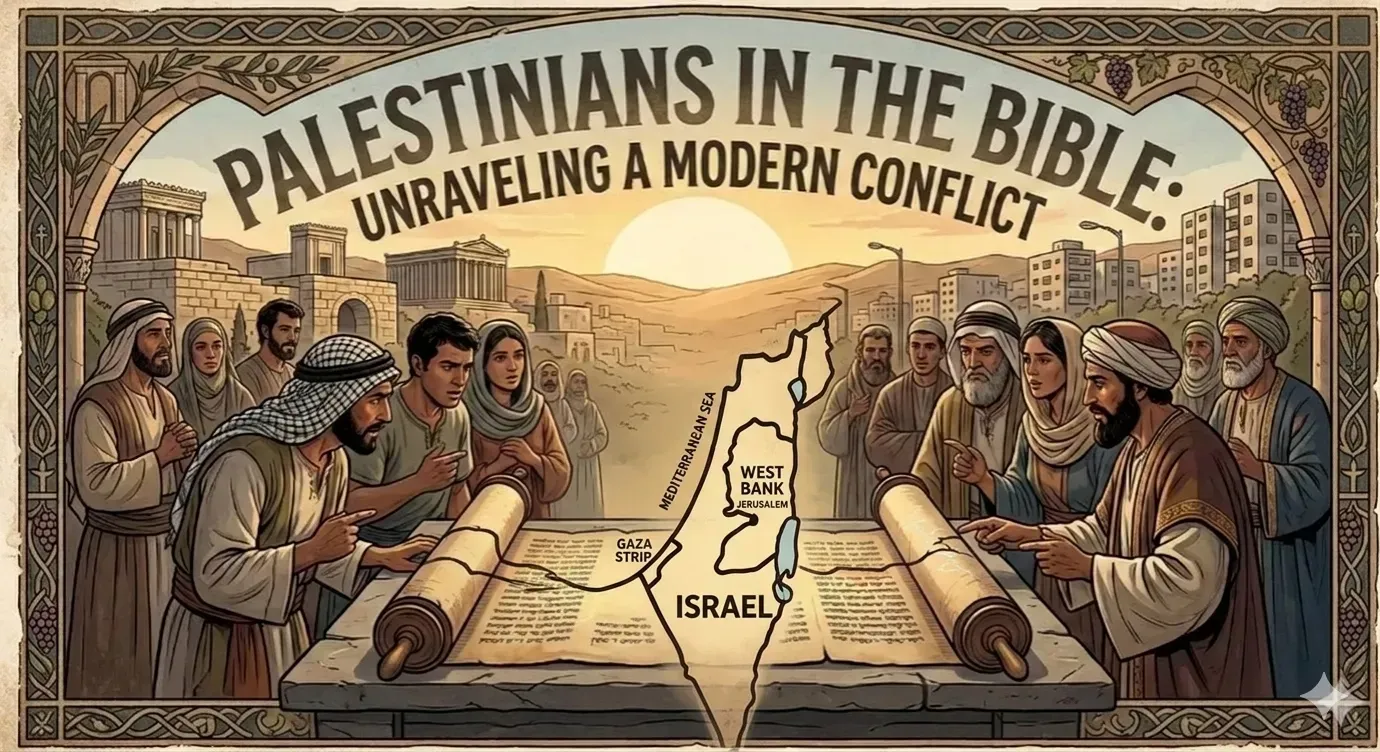
The ongoing conflict between Israel and Palestine captures global attention, often stirring deep-seated historical and religious questions. For many, particularly those viewing the situation through a scriptural lens, a central question arises: what is the connection between the Palestinians in the Bible and the people group we know today? This question is often fueled by a misunderstanding of names, timelines, and identities. Many mistakenly believe the modern conflict is a direct continuation of ancient biblical wars, like a replay of David versus Goliath.
This comprehensive guide seeks to bring clarity and historical accuracy to the conversation. We will delve deep into scripture, archaeology, and historical records to explore whether there is a direct link between the ancient Philistines and modern Palestinians. By examining the origins of the names, the people, and the conflict itself, we can foster a more informed and compassionate understanding. This article will provide a detailed look at the historical context, separating biblical narratives from modern political realities and offering a path forward rooted in truth and empathy.
Are Palestinians Mentioned in the Bible Directly?
When searching for a direct mention of Palestinians in the Bible, the simple answer is no. The term “Palestinian” as a specific ethno-national identity for the Arab people of the region is a modern development, primarily from the 20th century. The Bible, with the Old Testament texts dating back thousands of years and the New Testament compiled in the first century AD, does not use this term to describe any group of people.
The confusion often stems from the similarity between the words “Palestinian” and “Philistine.” The Philistines are a prominent group in the Old Testament, frequently depicted as formidable adversaries of the ancient Israelites. It is this phonetic resemblance that leads many to incorrectly equate the two.
The Philistines of the Old Testament
To understand why this connection is historically inaccurate, we must first understand who the Philistines were.
- Origins: The Philistines were part of a larger confederation known as the “Sea Peoples.” Archaeological and historical evidence, including Egyptian records, suggests they migrated from the Aegean region (modern-day Greece and Crete) to the coast of the Levant around the 12th century BC.
- Location: They established a pentapolis, a league of five major cities, in the coastal plain of what is now southern Israel and Gaza. These cities were Ashdod, Ashkelon, Ekron, Gath, and Gaza.
- Biblical Narrative: The Philistines are central figures in many Old Testament stories, most famously in the accounts of Samson (Judges 13-16) and the battle between David and the Philistine giant, Goliath of Gath (1 Samuel 17). They were a consistent military and political threat to the early Israelite kingdom.
- Cultural Identity: Their culture, including their pottery, architecture, and religious practices, showed distinct Aegean influences, setting them apart from the native Canaanite populations.
The Disappearance of the Philistines
Crucially, the Philistine people disappeared from the historical record long before the modern era. After being conquered by the Neo-Assyrian Empire in the 8th century BC and later by the Neo-Babylonian Empire under Nebuchadnezzar II around 604 BC, their distinct cultural identity faded. They were assimilated into the successive empires that ruled the region, and by the Persian and Hellenistic periods, the Philistines as a distinct people group ceased to exist. They were gone centuries before the time of Jesus and the writing of the New Testament.
Therefore, making a direct ethnic or genealogical link between the ancient Philistines and modern Palestinians is not supported by historical or archaeological evidence.
The Origin of the Name “Palestine”
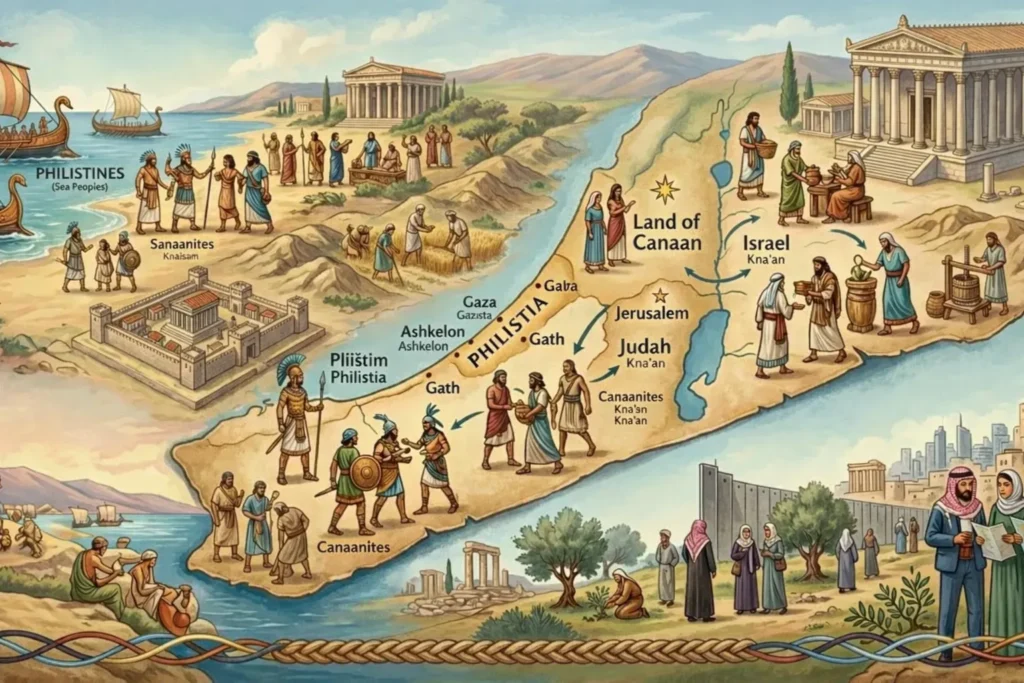
If the Philistines are not the ancestors of modern Palestinians, where did the name “Palestine” come from? The journey of this name is a key piece of the puzzle, revealing how a Roman administrative term evolved into a national identity.
The name’s etymology does indeed trace back to the Philistines. The Hebrew word for their land was Peleshet. The ancient Greeks, who had contact with the coastal region, Hellenized this term into Palaistinē. The historian Herodotus, writing in the 5th century BC, used this term to refer to the southern coastal region of Syria.
However, its application to the entire region known as the Holy Land was a much later development, imposed by the Roman Empire.
Roman Renaming: Syria Palaestina
In 132 AD, a Jewish revolt against Roman rule, known as the Bar Kokhba Revolt, broke out. After brutally suppressing the rebellion in 135 AD, the Roman Emperor Hadrian sought to erase Jewish identity from the land. As a punitive measure, he implemented several key changes:
- Renaming Jerusalem: The city of Jerusalem was razed and rebuilt as a Roman colony named Aelia Capitolina.
- Banning Jews: Jews were forbidden from entering the new city.
- Renaming the Province: The Roman province of Judaea was merged with Galilee and renamed Syria Palaestina.
This renaming was a deliberate act of political and cultural humiliation. By naming the province after Israel’s ancient enemies, the Philistines, Hadrian aimed to sever the deep-rooted connection between the Jewish people and their ancestral homeland. This Roman administrative term, Palaestina, became the standard name for the region for centuries to come.
| Period | Ruling Power | Regional Name | Significance |
|---|---|---|---|
| ~1200 BC | Egyptian Influence | Canaan / Peleshet | Philistines settle on the coast in the land of “Peleshet.” |
| ~1000 BC | Kingdom of Israel | Israel / Judah | Israelite kingdoms are the dominant power. |
| 135 AD | Roman Empire | Syria Palaestina | Emperor Hadrian renames Judaea to sever Jewish ties to the land. |
| 630s AD | Arab Caliphates | Jund Filastin | The region becomes an administrative district named “Filastin.” |
| 1920-1948 | British Mandate | Mandatory Palestine | The British administer the territory under this name. |
Over the following centuries, under Byzantine and then Arab rule, the name stuck. The Arabic term for the region became Filastin. The people living within this geographic area, who were a diverse mix of Jews, Samaritans, and increasingly, Arab Christians and Muslims following the Arab conquest in the 7th century, came to be associated with the land of “Palestine.” It was a regional, geographic identifier, not an ethnic one.
Who Are Modern Palestinians?
The identity of modern Palestinians is a product of this long and complex history. They are not a monolithic group but are primarily the Arabic-speaking people with deep, centuries-old roots in the land geographically known as Palestine. Their ancestry is a rich tapestry woven from the many peoples who have lived in, migrated to, or conquered the region over millennia. This includes:
- Indigenous peoples of the Levant from ancient times.
- Arabs who migrated to the region, especially after the Muslim conquest in the 7th century.
- Crusaders, Turks, and others who settled in the land.
The development of a distinct national Palestinian identity is a more recent phenomenon, emerging in the late 19th and early 20th centuries. This coincided with the rise of nationalism across the Arab world and, significantly, in response to the Zionist movement. As Jewish immigration to the region increased with the goal of establishing a national home, the Arab inhabitants began to forge their own collective national consciousness centered on their connection to the land and a desire for self-determination.
Therefore, while modern Palestinians are not the Philistines from the biblical narrative, their identity is deeply tied to the land, a land that was named “Palestine” long ago by an empire, with the name later embraced by its people as a symbol of their national heritage.
The Modern Israeli-Palestinian Conflict: A Political Dispute
Understanding that the search for Palestinians in the Bible leads to a case of mistaken identity is crucial for correctly framing the modern conflict. The conflict is not a continuation of ancient holy wars described in the Old Testament. It is a modern political and territorial dispute that began in earnest in the 20th century.
Key Milestones of the Modern Conflict:
- The Rise of Zionism (Late 19th Century): In response to centuries of persecution in Europe, the Zionist movement emerged with the goal of re-establishing a Jewish homeland in the historic Land of Israel. This led to waves of Jewish immigration.
- Arab Nationalism: Simultaneously, a sense of Arab nationalism was growing throughout the Ottoman Empire, with a desire for independence and sovereignty.
- The British Mandate (1920-1948): After World War I, the British were granted a mandate over Palestine. They struggled to manage the conflicting promises made to both Jews and Arabs, leading to rising tensions and violence.
- The 1947 UN Partition Plan: The United Nations proposed a plan to divide Mandatory Palestine into separate Arab and Jewish states. The Jewish leadership accepted the plan, while Arab leaders rejected it.
- The 1948 War: Following the British withdrawal and Israel’s declaration of independence in May 1948, war broke out between the new state of Israel and its Arab neighbors. The war resulted in an Israeli victory but also led to the displacement of over 700,000 Palestinians, an event they call the Nakba (“Catastrophe”).
This history of displacement, occupation, war, and competing claims over land, sovereignty, and human rights is the foundation of the conflict today. It is a clash over national aspirations, security, borders, and resources, not a direct fulfillment of biblical prophecy or a war between ancient peoples.
A Biblical Perspective on Justice, Mercy, and Land
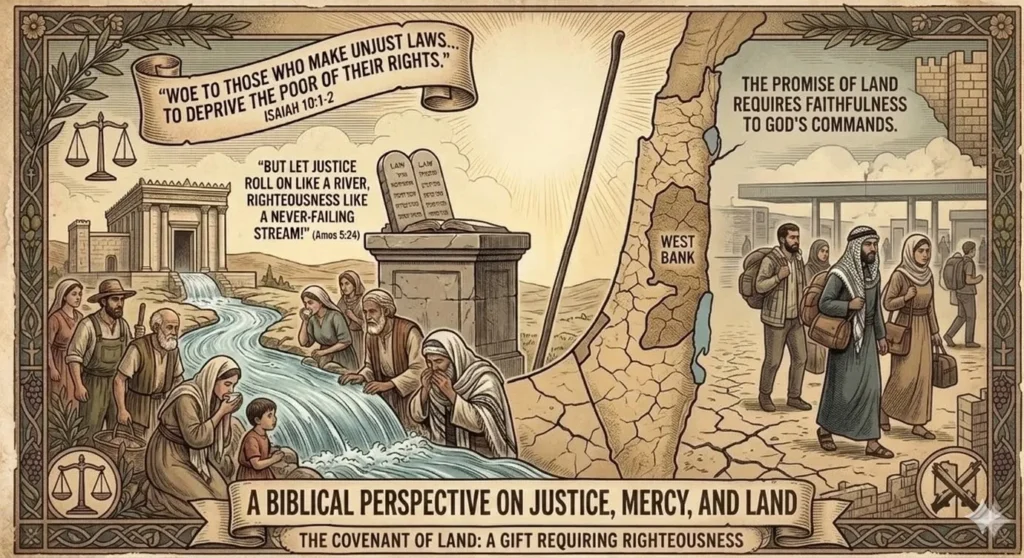
While we cannot find Palestinians in the Bible by that name, the scripture offers timeless principles that are profoundly relevant to how we view the conflict. The Bible is not a simple political playbook, but a guide for righteousness, justice, and compassion.
The Covenant of Land
The Old Testament clearly documents God’s covenant with Abraham and his descendants, promising them the land of Canaan (Genesis 15:18-21). This promise is a cornerstone of Jewish theology and identity and is fundamental to the belief in Israel as the Promised Land.
However, the Bible also attaches conditions to this gift of land. The continued possession and enjoyment of the land were linked to Israel’s faithfulness to God’s commands, particularly the commands concerning justice and righteousness.
Prophets throughout the Old Testament warned that injustice would lead to exile from the land.
- Isaiah 10:1-2: “Woe to those who make unjust laws, to those who issue oppressive decrees, to deprive the poor of their rights and withhold justice from the oppressed of my people…”
- Amos 5:24: “But let justice roll on like a river, righteousness like a never-failing stream!”
The Command to Love the Foreigner
A recurring theme in the Torah is the ethical treatment of the “foreigner” or “stranger” living among the Israelites. God repeatedly reminds His people of their own history as oppressed foreigners in Egypt as the basis for empathy and just treatment of others.
- Exodus 23:9: “Do not oppress a foreigner; you yourselves know how it feels to be foreigners, because you were foreigners in Egypt.”
- Leviticus 19:34: “The foreigner residing among you must be treated as your native-born. Love them as yourself, for you were foreigners in Egypt. I am the Lord your God.”
These principles are not nullified by political conflict. They call believers to a higher standard of compassion that transcends national or ethnic lines.
The New Testament and a Kingdom Not of This World
The New Testament, centered on the life and teachings of Jesus Christ, universalizes the message of salvation and reconciliation. Jesus’s kingdom is “not of this world” (John 18:36), meaning it is not defined by earthly borders, political power, or ethnic identity.
The Apostle Paul powerfully articulates this new reality in Christ:
- Galatians 3:28: “There is neither Jew nor Gentile, neither slave nor free, nor is there male and female, for you are all one in Christ Jesus.”
- Ephesians 2:14-15: “For he himself is our peace, who has made the two groups one and has destroyed the barrier, the dividing wall of hostility… His purpose was to create in himself one new humanity out of the two, thus making peace.”
For Christians, this means that our primary identity is in Christ. This identity compels us to see both Israelis and Palestinians as people created in the image of God, equally in need of His grace and equally deserving of justice, security, and peace. It calls us to pray for the peace of Jerusalem (Psalm 122:6) in its fullest sense, a peace that includes well-being and justice for all its inhabitants.
FAQs: Answering Common Questions About Palestinians in the Bible
Q1: So to be clear, are modern Palestinians related to the Philistines?
No. There is no direct genealogical or historical link between the ancient Philistines of the Bible and modern Palestinians. The Philistines were a non-Semitic people from the Aegean who disappeared from history over 2,500 years ago. Modern Palestinians are a primarily Semitic, Arabic-speaking people whose identity formed over centuries and was consolidated in the 20th century.
Q2: Why do some people insist on connecting Palestinians to the Philistines?
This connection is often made for political reasons or due to a simple misunderstanding of history. For some, linking Palestinians to the biblical enemies of Israel is a way to delegitimize their claims to the land. For others, it’s an honest mistake based on the similar-sounding names.
Q3: If the term “Palestine” comes from the Romans, is it a legitimate name?
Yes. While the name was originally imposed by an occupying empire, it has been in continuous use for the region for nearly 2,000 years. Over time, the Arab people of the region adopted it as their own. Names of countries and peoples often have complex origins (e.g., “America” is named after an Italian explorer), but their legitimacy comes from their accepted use by the people themselves.
Q4: Does the Bible support one side over the other in the modern conflict?
The Bible is not a partisan document for a 21st-century political conflict. It contains God’s promise of land to Israel, but it also contains universal commands for justice, mercy, and love for all people. Believers are called to hold both truths. Applying scripture requires careful interpretation that prioritizes God’s character, His love for justice and His compassion for all people, including the poor and the oppressed, regardless of their nationality.
Q5: What should a Christian’s posture be toward the Israeli-Palestinian conflict?
A Christian posture should be one of prayer, empathy, and a commitment to truth and justice for all. This means:
- Praying for peace, reconciliation, and the well-being of both Israelis and Palestinians.
- Mourning with all who suffer, recognizing the pain and trauma on both sides.
- Speaking out against injustice, violence, and dehumanizing rhetoric, no matter who it comes from.
- Supporting efforts toward a just and lasting peace that provides security, dignity, and freedom for both peoples.
- Remembering that the ultimate solution is found in the gospel of Jesus Christ, which has the power to reconcile enemies and create a new humanity.
Conclusion: Moving Beyond Myths to a More Informed Faith
The question of finding Palestinians in the Bible ultimately reveals a historical and etymological misunderstanding. The conflict we witness today is not an ancient biblical war reborn; it is a modern struggle over land, rights, and nationhood.
By untangling the history, we can move beyond simplistic and often harmful narratives. We can affirm the historical connection of the Jewish people to the land without erasing the presence and identity of Palestinians. We can acknowledge the pain and injustice experienced by Palestinians without denying Israel’s right to exist in security.
For people of faith, the Bible provides not a political road map, but a moral and ethical compass. It points us toward a God who loves justice, shows mercy, and calls His followers to be peacemakers. Our role is not to choose a side in a political battle but to stand on the side of God’s heart, a heart that breaks for the suffering of both Israelis and Palestinians and longs to see them live in a just and lasting peace.