
What does it truly mean when the Bible says there is no partiality with God? This profound statement, found in Romans 2:11, is far more than a simple declaration of divine fairness. It is a cornerstone of biblical theology that reveals the very character of God and has radical implications for how we live, worship, and relate to one another. Understanding this principle requires us to journey through the corridors of history, language, and scripture to grasp its full weight.
This comprehensive exploration will unpack the rich meaning behind God’s impartiality. We will examine the original Greek and Hebrew terms, trace the concept through the Old and New Testaments, and uncover how the truth that there is no partiality with God should transform our churches and our personal lives. This isn’t just a theological exercise; it’s an invitation to see God and the world through a lens of perfect, unbiased justice and love.
The Context of Romans: Why Paul Declared God’s Impartiality
To understand the power of Romans 2:11, we must first look at its immediate surroundings. The Apostle Paul, in his letter to the church in Rome, is building a powerful, systematic argument about sin, judgment, and salvation.
In the first chapter of Romans, Paul outlines the unrighteousness of the Gentile (non-Jewish) world. He details how humanity, despite having a general revelation of God through creation, turned away to worship created things rather than the Creator. This rebellion led to a debased mind and a society filled with every kind of wickedness. The verdict is clear: the Gentile world stands guilty before a holy God.
Then, in chapter 2, Paul makes a dramatic turn. He confronts his Jewish audience, who might have been nodding along in agreement as he condemned the Gentiles. The Jewish people had a special covenant with God, possessing His divine Law (the Torah) and the sign of circumcision. They might have felt secure, believing their religious heritage and knowledge of the Law placed them in a superior position.
Paul dismantles this false security. He argues that merely having the Law is not enough; one must obey it. He levels the playing field, stating that both Jews and Gentiles who sin will be judged.
This is where Romans 2:11 lands with climactic force: “For there is no partiality with God.” Paul uses this truth as the foundation for his argument that God’s judgment is perfectly just and cannot be influenced by external factors.
- Heritage does not save: Being a descendant of Abraham is not a free pass.
- Privilege does not protect: Possessing the Scriptures does not excuse disobedience.
- Outward signs do not justify: Religious rituals, like circumcision, are meaningless without a changed heart.
Paul’s declaration that there is no partiality with God serves to show that all humanity, Jew and Gentile alike, is in the same desperate situation. Everyone has sinned, and everyone is accountable to the same, perfectly just Judge. This sets the stage for the glorious solution Paul will present later: salvation is not based on human merit or status, but on God’s grace through faith in Jesus Christ, available to all people on equal terms.
Unpacking the Language: What “Partiality” Really Means
When modern English Bibles use the word “partiality” or “favoritism,” they are translating a unique Greek word with deep Hebrew roots. Understanding this term, prosōpolēmpsia, unlocks a richer understanding of God’s character.
The Greek Word: Prosōpolēmpsia
The word Paul uses in Romans 2:11 is προσωπολημψία (prosōpolēmpsia). This is a compound word that literally means “to receive a face.”
- Prosōpon (πρόσωπον): This means “face,” “appearance,” or “person.”
- Lambanō (λαμβάνω): This means “to take,” “to receive,” or “to accept.”
So, the literal picture is one of “accepting someone’s face.” This idiom describes making a judgment about a person based on their external appearance, social standing, wealth, or influence, rather than on the merits of their case or the reality of their character. It’s the act of looking at someone’s “face”, their public persona, and letting that sway your decision. Paul’s message is clear: God does not do this. He looks past the face to the heart.
The Hebrew Roots: “Lifting the Face”
Interestingly, prosōpolēmpsia is not a common word in classical Greek literature. Its origins are distinctly biblical. It was created by Greek-speaking Jews to translate a Hebrew idiom found throughout the Old Testament: nasa panim (נָשָׂא פָּנִים).
This Hebrew phrase literally means “to lift up the face.” In a positive sense, it could mean to show favor or grant a request, like a king “lifting his face” toward a subject. However, in legal and ethical contexts, it carried a strong negative warning against showing favoritism in judgment.
The Old Testament repeatedly commands judges and leaders to avoid “lifting the face”:
- Deuteronomy 10:17: “For the LORD your God is God of gods and Lord of lords, the great, the mighty, and the awesome God, who shows no partiality and takes no bribe.” Here, God’s impartiality is tied directly to His supreme power and holiness.
- Leviticus 19:15: “You shall do no injustice in judgment. You shall not be partial to the poor or defer to the great, but in righteousness shall you judge your neighbor.” This verse highlights that partiality can swing both ways, favoring the rich or pitying the poor, both are a perversion of justice.
- 2 Chronicles 19:7: King Jehoshaphat instructs the judges of Judah, saying, “Now then, let the fear of the LORD be upon you. Be careful what you do, for there is no injustice with the LORD our God, or partiality or taking bribes.”
When the Hebrew Bible was translated into Greek (the version known as the Septuagint), the translators often rendered nasa panim with the literal Greek equivalent, lambanō prosōpon. Paul, being a Pharisee deeply trained in the Scriptures, adopted this Hebraic concept and the specific terminology to make his point.
Comparing Bible Translations
Because “face-receiving” is not a natural English phrase, translators use functional equivalents to convey the meaning. This table shows how different popular versions handle the concept, each adding a slightly different nuance.
| Bible Version | Translation of Prosōpolēmpsia | Nuance Emphasized |
|---|---|---|
| KJV | “Respect of persons” | An older, formal phrase for favoritism. |
| ESV, NASB | “Partiality” | Stresses biased treatment and unfairness. |
| NIV, NLT, CSB | “Favoritism” | Highlights giving unfair preference. |
| NET Bible | “Does not show favoritism” | A clear, modern rendering of the idea. |
All these translations point to the same profound truth: God’s judgment is incorruptible. He cannot be swayed by the external factors that so often influence human beings. The principle of no partiality with God means His justice is pure, perfect, and absolute.
No Partiality With God: A Theme Throughout Scripture
The declaration that there is no partiality with God is not confined to Romans 2:11. It is a consistent theme woven through the entire biblical narrative, revealing a core attribute of God’s character.
In the Old Testament Law and Wisdom
The Old Testament lays the foundation for understanding God’s impartiality. As we’ve seen, the Law given to Moses explicitly forbids human judges from showing partiality, because they are to reflect the character of the ultimate Judge.
- Exodus 23:3, 6: “Nor shall you be partial to a poor man in his dispute… You shall not pervert the justice due to your poor in his dispute.” Justice must be blind to economic status.
- Proverbs 24:23: “These also are sayings of the wise: To show partiality in judging is not good.” Wisdom literature reinforces this legal principle as a general ethical good.
- The Story of Job: In his suffering, Job appeals to God’s justice, confident that God, unlike his friends, will judge him righteously. He states, “He will not pay attention to the rich more than to the poor, for they are all the work of his hands” (Job 34:19). Job understood that before the Creator, all people are equal.
In the Ministry of Jesus Christ
Jesus embodied the principle of no partiality with God. His life and teachings consistently broke down the social, religious, and cultural barriers that created division and favoritism in his day.
- He Associated with Outcasts: Jesus was criticized by the religious elite for eating with “tax collectors and sinners” (Mark 2:16). He showed honor and offered salvation to those on the margins of society, like Zacchaeus the tax collector and the Samaritan woman at the well.
- He Challenged the Powerful: Jesus was not intimidated by wealth or status. He warned of the spiritual danger of riches (Mark 10:23) and rebuked the hypocrisy of the Pharisees, the respected religious leaders of his day (Matthew 23).
- His Teachings Promoted Equality: In the Parable of the Good Samaritan (Luke 10:25-37), Jesus redefined the concept of “neighbor,” extending it beyond ethnic and religious lines. His core command to “love your neighbor as yourself” is a direct challenge to all forms of partiality.
Even his enemies recognized his impartiality. In Mark 12:14, the Pharisees and Herodians try to trap him, saying, “Teacher, we know that you are true and do not care about anyone’s opinion. For you are not swayed by appearances, but truly teach the way of God.” Though their motives were malicious, their description of Jesus was perfectly accurate.
In the Early Church
The apostles carried this foundational truth into the life of the early church. They understood that the gospel erases the worldly distinctions that lead to favoritism.
- Peter’s Revelation: In Acts 10, the Apostle Peter has a vision that leads him to the home of Cornelius, a Roman centurion. This was a shocking breach of Jewish custom. Upon seeing God’s Spirit fall upon these Gentiles, Peter declares, “Truly I understand that God shows no partiality, but in every nation anyone who fears him and does what is right is acceptable to him” (Acts 10:34-35). This was a pivotal moment, officially opening the church to the non-Jewish world.
- James’s Stern Warning: The book of James contains the most direct application of this principle within the church community. James 2:1-4 gives a vivid example: “My brothers, show no partiality as you hold the faith in our Lord Jesus Christ… For if a man wearing a gold ring and fine clothing comes into your assembly, and a poor man in shabby clothing also comes in, and if you pay attention to the one who wears the fine clothing… have you not then made distinctions among yourselves and become judges with evil thoughts?” James calls partiality based on wealth a sin that violates the “royal law” of loving your neighbor.
- Paul’s Gospel of Unity: Paul repeatedly emphasizes that in Christ, social and ethnic divisions are made obsolete. His famous declaration in Galatians 3:28 is the ultimate expression of this: “There is neither Jew nor Greek, there is neither slave nor free, there is no male and female, for you are all one in Christ Jesus.” The fact that there is no partiality with God in salvation leads to a unified community on earth.
From the Law of Moses to the letters of Paul, the Bible is clear: God is an impartial Judge and Savior, and He calls His people to reflect that same character.
The Theological Weight of God’s Impartiality
The principle that there is no partiality with God is not just an ethical guideline; it has profound theological implications for our understanding of God, judgment, and the gospel.
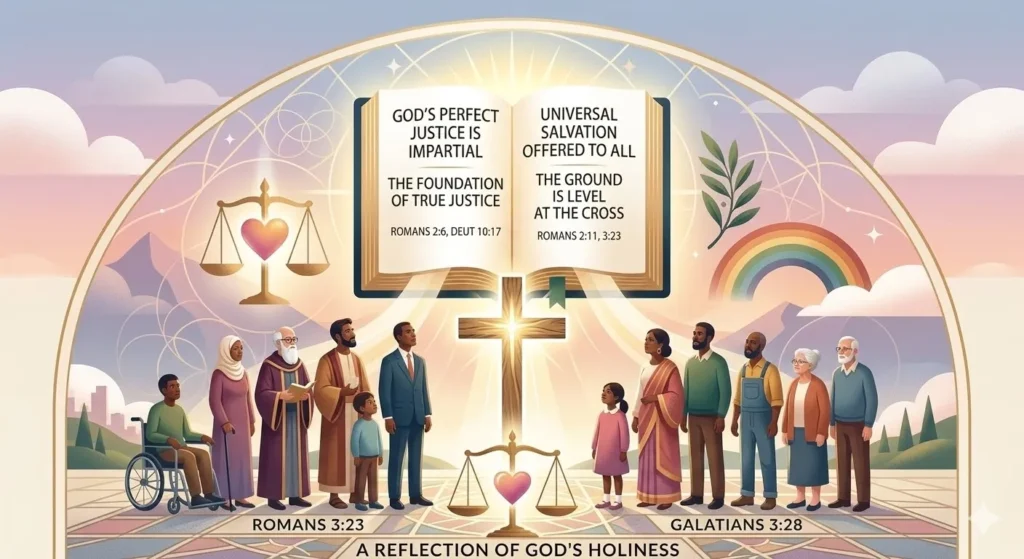
1. The Foundation of True Justice
God’s impartiality is the very bedrock of His justice. Human justice is often flawed and fallible. It can be influenced by wealth, power, race, connections, or public opinion. But God’s justice is perfect.
- Universal Standard: God judges every single person by the same righteous standard. As Romans 2:6 states, “He will render to each one according to his works.” No one gets a different test or a more lenient judge.
- Incorruptible Character: Deuteronomy 10:17 links God’s impartiality with the fact that He “takes no bribe.” God cannot be bought, manipulated, or swayed. His judgments are based solely on truth and righteousness.
- Judgment of the Heart: Humans judge by outward appearance, but God judges the inner reality. He sees past our masks, our religious performances, and our social status to “judge the secrets of men’s hearts” (Romans 2:16). 1 Samuel 16:7 famously says, “The LORD sees not as man sees: man looks on the outward appearance, but the LORD looks on the heart.”
This can be a terrifying thought for those who rely on their own goodness or status, but it is a great comfort for those who feel overlooked or oppressed by human systems. Before the throne of God, all earthly advantages and disadvantages disappear.
2. The Ground is Level at the Cross
The doctrine of no partiality with God is essential to the gospel message. If God showed partiality, then salvation might only be for a specific ethnic group, social class, or level of intellect. But Paul’s argument in Romans is that God’s impartiality in judgment leads to impartiality in salvation.
Paul’s logic is devastatingly simple:
- Everyone is judged by the same standard (Romans 2:11).
- Everyone fails to meet that standard: “For all have sinned and fall short of the glory of God” (Romans 3:23).
- Therefore, everyone, without distinction, needs the same solution.
This is why the gospel is such good news. Salvation is not something we earn through our heritage, our good works, or our status. It is a free gift offered to all. The ground is perfectly level at the foot of the cross. The CEO and the janitor, the scholar and the uneducated, the respected churchgoer and the societal outcast, all come to God on the exact same terms: as sinners in need of a Savior, receiving grace through faith in Jesus Christ.
3. A Reflection of God’s Holiness
Ultimately, the fact that there is no partiality with God flows from His holy nature. Holiness means He is utterly “other”, separate from sin, corruption, and the flawed biases of His creation. His actions are always perfectly consistent with His character. Because He is perfectly holy, He must be perfectly just. And because He is perfectly just, He must be perfectly impartial.
Practical Applications for Today’s Christian and Church
Understanding that there is no partiality with God is not meant to remain an abstract theological concept. It is a transformative truth that should radically reshape our actions, attitudes, and communities.
In Church Leadership and Structure
Church leaders, pastors, elders, and deacons, are called to model God’s impartiality. This means actively resisting the temptation to give preferential treatment to certain individuals.
- Resist Favoring the Wealthy: James 2 gives a direct command against giving the best seats to the rich. Churches must ensure that financial contributions do not equate to greater influence or a louder voice in decision-making.
- Avoid the Pull of Charisma and Influence: It is easy to be drawn to the charismatic, the successful, or the well-connected. Church leadership must consciously cultivate and empower believers from all walks of life, not just those who are polished or popular.
- Ensure Fair Processes: When dealing with church discipline, volunteer placement, or leadership selection, the standards must be applied equally to everyone, regardless of their family name, tenure in the church, or social standing.
In Our Community and Relationships
The principle of no partiality with God must be visible in the way we treat one another within the body of Christ.
- Welcome the Stranger: Churches should be the most welcoming places on earth for people of every race, ethnicity, economic level, and background. This requires more than a friendly greeting; it requires a genuine effort to build relationships across social divides.
- Value Every Member: In Christ, every believer is an equal and indispensable part of the body (1 Corinthians 12:12-27). The elderly widow’s wisdom is as valuable as the young entrepreneur’s energy. The insights of a new believer are as important as those of a seminary professor.
- Challenge Cliques and Social Hierarchies: We must be intentional about dismantling social silos within our churches. This means purposefully sitting with new people, inviting someone from a different background over for a meal, and celebrating the diversity within our congregation as a gift from God.
In Evangelism and Mission
The truth that there is no partiality with God fuels our mission to the world.
- The Gospel is for Everyone: No person or people group is beyond the reach of the gospel. We have a mandate to share the good news across all cultural, social, and economic barriers. We must reject any “us vs. them” mentality.
- Love Our Neighbors: Our evangelism must be coupled with a genuine love for our neighbors, which includes fighting against injustices like racism and economic oppression that create systems of partiality in the world. As a credible source of social statistics, you can learn more about these issues from organizations like the Pew Research Center.
In Personal Self-Examination
Finally, this doctrine calls us to look inward.
- Examine Your Own Biases: We all have unconscious biases. We must ask the Holy Spirit to reveal to us where we show partiality in our own hearts, whether it’s based on appearance, political views, education, or lifestyle.
- Live with Integrity: Knowing that God judges the heart and not the “face” should motivate us to live authentically. It challenges us to align our private thoughts and our public actions with our professed faith, knowing that God sees all.
The call to live without partiality is a high one, and we will fail. But the good news is that we serve a God who shows no partiality in His grace. He forgives our failures and empowers us by His Spirit to increasingly reflect His beautiful, impartial love to the world.
Frequently Asked Questions (FAQ)
Q1: Does “no partiality with God” mean that God treats everyone exactly the same?
Not exactly. It means God judges everyone by the same righteous standard and that salvation is offered to all on the same terms (faith in Christ). It does not mean everyone has the same circumstances, gifts, or roles in life. For example, God gave different roles to men and women and established different covenants with different people (like Abraham and Israel) at different times. However, in matters of ultimate judgment and access to salvation, He shows no favoritism based on race, gender, or status.
Q2: If God is impartial, why did He choose Israel as His special people in the Old Testament?
This is a great question. God’s choice of Israel was not based on their being better or more deserving than other nations (Deuteronomy 7:7-8 says He chose them out of love and faithfulness to His promise to Abraham). Israel was chosen for a specific mission: to be a “kingdom of priests” and a “light to the nations” through whom the Messiah, the Savior of the entire world, would come. Their election was for the purpose of blessing all humanity, not for their own exclusive benefit. Thus, God’s plan through Israel was the ultimate expression of His impartial love for the world.
Q3: How can I fight partiality in my own heart and in my church?
Fighting partiality starts with prayer and self-awareness. Ask God to reveal your hidden biases. Then, be intentional:
- Be a Bridge-Builder: Purposely initiate conversations and friendships with people who are different from you.
- Listen to Others’ Stories: Take time to understand the experiences of people from different backgrounds.
- Speak Up: When you see partiality happening in your church or community, whether it’s a subtle joke or an unjust system, gently and lovingly speak up for what is right.
- Celebrate Diversity: View the differences within your church not as a problem to be managed, but as a beautiful reflection of the creativity of our impartial God.
Q4: Is showing favor to your own family or friends a form of sinful partiality?
Not necessarily. It is natural and good to have special affection and responsibility for those closest to you (1 Timothy 5:8). The sin of partiality occurs when this natural affection leads to injustice. For example, if you were a judge, you could not rule in favor of your son if he was guilty. In the church, it means you cannot give a leadership position to a friend who is unqualified over a stranger who is qualified. The key is whether our preferences violate the principles of justice, righteousness, and love for our neighbor.
Q5: Where else does the Bible talk about God’s impartiality?
Besides the key passages in Romans, Acts, and James, the principle is found in many other places:
- Ephesians 6:9: Masters are told to treat their slaves fairly, “knowing that he who is both their Master and yours is in heaven, and that there is no partiality with him.”
- Colossians 3:25: “For the wrongdoer will be paid back for the wrong he has done, and there is no partiality.”
- 1 Peter 1:17: “And if you call on him as Father who judges impartially according to each one’s deeds, conduct yourselves with fear throughout the time of your exile.”