If you have ever felt frustrated by your own repeated mistakes, you are not alone. Many believers read the Bible and wonder why the Christian life still feels like an ongoing struggle. The truth is, the tension between your desires and your actions does not mean you are failing. It means you are engaged in a very real spiritual conflict. Understanding Romans 7 and 8 is the key to unlocking how this battle works and, more importantly, how you can experience lasting freedom.
In this comprehensive guide, we will explore the profound truths hidden within Romans 7 and 8. We will uncover why the Apostle Paul used the analogy of marriage to explain our relationship to sin, how the mind acts as the primary battlefield, and why the Holy Spirit is the ultimate source of victory. By the end of this article, you will have a clear, actionable understanding of how to step out of a cycle of defeat and walk confidently in the freedom that Christ purchased for you.
Understanding the Context of Romans 7 and 8
To truly grasp the power of Romans 7 and 8, we must first look at the broader context of Paul’s letter to the church in Rome. Paul wrote this letter to explain the comprehensive nature of the gospel-how it saves us, how it transforms us, and how it unites us.
When we arrive at Romans 7 and 8, Paul transitions from discussing our justification (how we are made right with God) to our sanctification (how we grow in holiness). Many people mistakenly read these chapters as a story of a powerless Christian trapped in endless defeat. In reality, Romans 7 and 8 describe a real conflict that exists only because something magnificent has already happened in your life. The tension between the flesh and the Spirit exists not because sin still owns you, but because you have finally been set free from its total control. Before Christ, there was no battle-only total bondage.
Romans 7 and 8: The Law, Sin, and the Marriage Analogy
Paul uses marriage language in the early verses of Romans 7 to explain something crucial about our spiritual identity. Before we knew Christ, we were bound to sin, legally and spiritually, much like a spouse is bound by a marriage covenant. In this state, sin held absolute authority over our lives.
What Romans 7 Teaches About Our Former Marriage
The law of God is good, but it only served to expose our toxic relationship with sin; it could not break it. Paul explains this clearly:
“So then, if while her husband lives she is joined to another man, she shall be called an adulteress. But if her husband dies, she is free from the law…” (Romans 7:3)
Then, Paul makes a shocking declaration that changes everything:
“You also have become dead to the law through the body of Christ, that you may be married to another-to Him who was raised from the dead.” (Romans 7:4)
The only way out of that former marriage to sin was death. And death is exactly what happened. When Christ died on the cross, we died with Him. Sin no longer possesses any legal rights over us. The flesh may still speak, but it no longer holds the throne.
A Comparison of Life Before and After Christ
To better understand the shift described in Romans 7 and 8, review the table below:
| Aspect of Life | Before Christ (Under the Law) | After Christ (Under Grace) |
|---|---|---|
| Relationship to Sin | Legally bound and enslaved | Legally divorced and free |
| Power Source | Self-effort and human willpower | The indwelling Holy Spirit |
| Focus of the Mind | Carnal things, fear, and guilt | Spiritual things, life, and peace |
| Ultimate Result | Condemnation and death | No condemnation and eternal life |
The Voice of the Flesh vs. The Throne of Christ
As we dive deeper into Romans 7 and 8, we encounter one of the most honest descriptions of human frustration ever written. Romans 7 vividly describes the inner turmoil every believer knows all too well:
“For what I will to do, that I do not practice; but what I hate, that I do.” (Romans 7:15)
Why the Apostle Paul Cries Out in Romans 7
When Paul writes these words, he is not excusing sinful behavior. Instead, he is exposing the absolute limits of self-effort. The law of God can tell you exactly what is right, but it possesses no power to help you live it out. The flesh thrives when we try to overcome sin without relying on Christ, even after we have received salvation.
This sheer exhaustion of trying to be good enough leads Paul to cry out in desperation:
“O wretched man that I am! Who will deliver me from this body of death?” (Romans 7:24)
And then comes the glorious answer that bridges the gap between Romans 7 and 8:
“I thank God-through Jesus Christ our Lord!” (Romans 7:25)
The victory over sin is not found in a specific method, a self-help program, or sheer willpower. The victory is found in a Person.
Romans 7 and 8: The Battlefield of the Mind
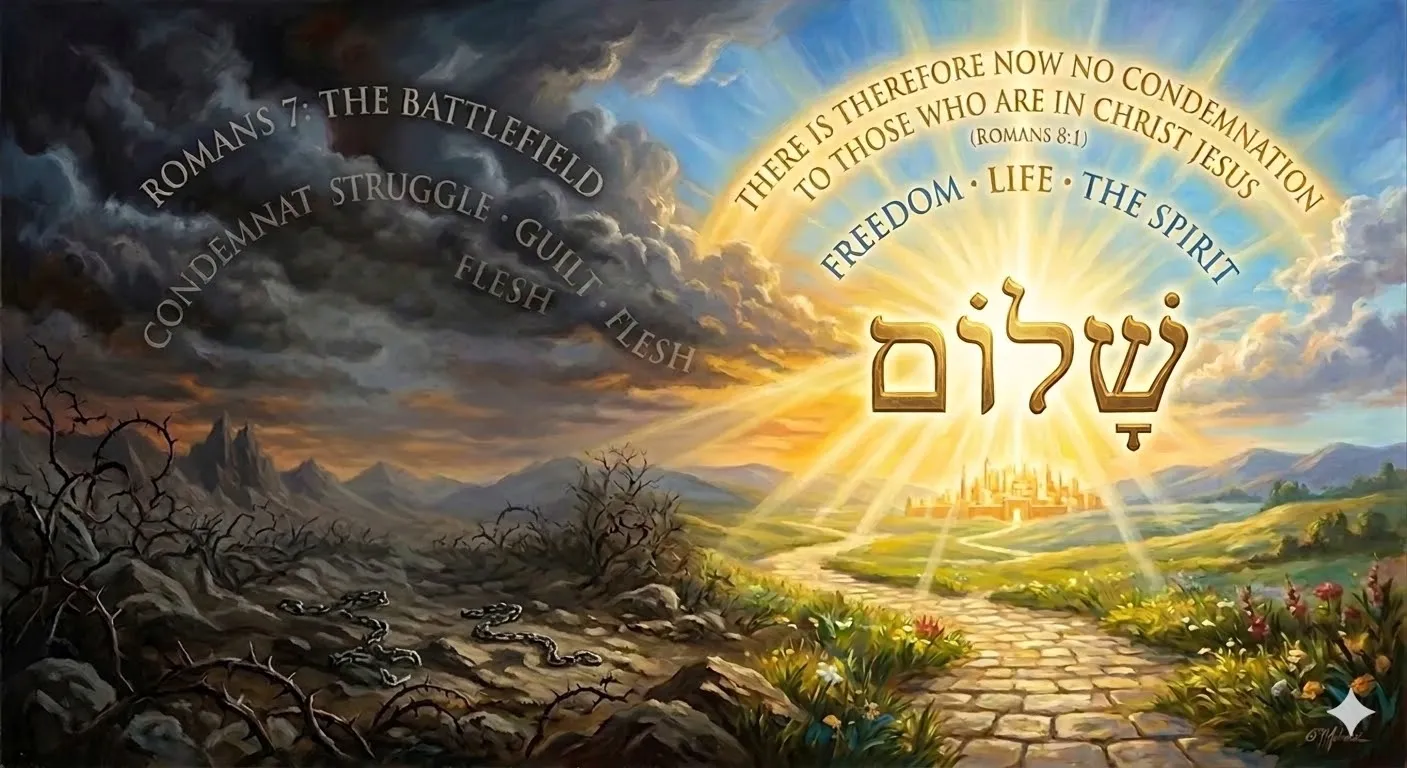
The transition from chapter 7 to chapter 8 is one of the most triumphant shifts in the entire Bible. Romans 8 does not begin with a heavy command; it begins with a liberating declaration:
“There is therefore now no condemnation to those who are in Christ Jesus…” (Romans 8:1)
Condemnation fuels the flesh, leading to a cycle of guilt and repeated failure. Freedom, on the other hand, empowers the Spirit. As we explore Romans 7 and 8, we learn exactly why the battle feels so intense and where it is fought: the mind.
Shifting Your Focus from Flesh to Spirit
Paul reveals the mechanics of this spiritual battle:
“For those who live according to the flesh set their minds on the things of the flesh, but those who live according to the Spirit, the things of the Spirit.” (Romans 8:5)
The struggle between the flesh and the Spirit is not merely about how hard you try; it is about where you place your focus. What we set our minds on determines which realm we walk in daily.
- The Carnal Mind: Animated by fear, guilt, control, anxiety, and self-reliance.
- The Spiritual Mind: Animated by life, peace, trust, surrender, and grace.
The mind acts as the steering wheel of your life. Where the mind goes, your actions will inevitably follow.
4 Steps to Renew Your Mind Daily
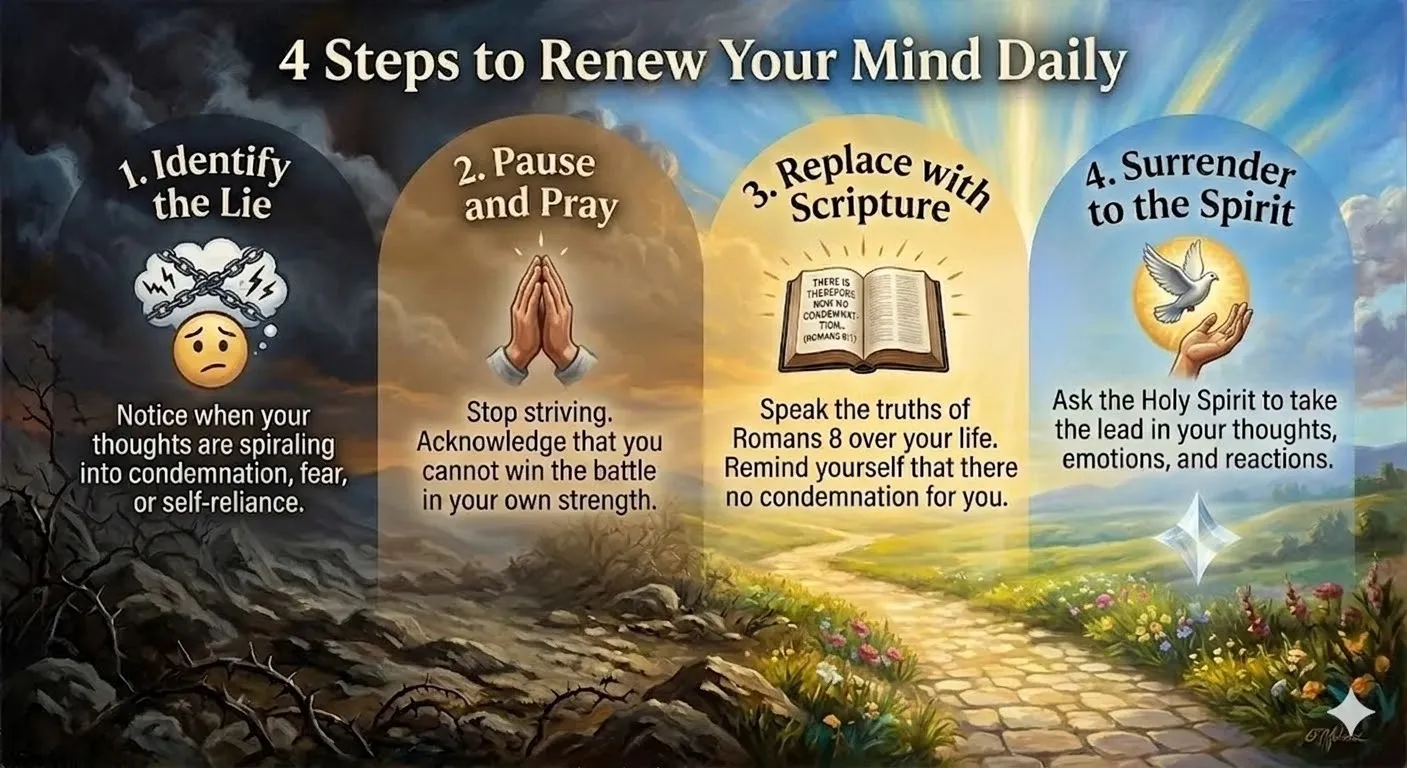
To live out the truths of Romans 7 and 8, you must actively participate in renewing your mind. Here is a practical approach:
- Identify the Lie: Notice when your thoughts are spiraling into condemnation, fear, or self-reliance.
- Pause and Pray: Stop striving. Acknowledge that you cannot win the battle in your own strength.
- Replace with Scripture: Speak the truths of Romans 8 over your life. Remind yourself that there is no condemnation for you.
- Surrender to the Spirit: Ask the Holy Spirit to take the lead in your thoughts, emotions, and reactions.
The Indwelling Spirit: The Key to Romans 7 and 8
The message of Romans 7 and 8 makes one thing unmistakably clear: you already have the tool necessary to conquer sin and death. It is not an abstract concept; it is the presence of the Holy Spirit.
“If the Spirit of Him who raised Jesus from the dead dwells in you, He who raised Christ from the dead will also give life to your mortal bodies…” (Romans 8:11)
How the Holy Spirit Empowers Believers
Think about the magnitude of that promise. The exact same Spirit that shattered the power of death and raised Jesus from the grave now lives inside of you. The Spirit is not just visiting on Sundays. The Spirit is not just hovering nearby when you behave well. The Spirit is dwelling permanently within you.
We do not try to overcome sin in order to earn life. We overcome sin because eternal life already lives inside of us. Jesus did not just forgive our sins; He utterly destroyed the power of sin over our lives.
“The law of the Spirit of life in Christ Jesus has made me free from the law of sin and death.” (Romans 8:2)
This means the Christian life is not about endless, grueling resistance. It is about union. The flesh only dominates our behavior when we forget who we are united to. Victory is not found in striving harder; it is found in abiding deeper.
Practical Application of Romans 7 and 8
Knowing the theology of Romans 7 and 8 is vital, but translating it into your daily life is where true transformation occurs. The moment we set our minds on Christ, the Spirit takes the lead. And where the Spirit leads, life and peace will always follow.
Here are a few ways to practically apply the lessons from Romans 7 and 8:
- Stop fighting alone: When temptation strikes, do not try to white-knuckle your way through it. Yield to the Spirit immediately.
- Reject condemnation: When you fail, confess it quickly and remind yourself of Romans 8:1. Do not wallow in guilt.
- Cultivate spiritual focus: Read the Bible, listen to worship music, and surround yourself with community to keep your mind set on the Spirit.
- Celebrate the struggle: Remember that the war between flesh and Spirit is not proof of your failure; it is evidence of your new life. You fight because you are free. You struggle because you are spiritually alive.
The tool to conquer sin and death is not discipline alone. It is not theological knowledge alone. It is Jesus Christ Himself-crucified, risen, and now dwelling within us through the Holy Spirit. Set your mind on Him, and the Spirit will do what the flesh never could.
Frequently Asked Questions About Romans 7 and 8 (FAQ)
What is the main difference between Romans 7 and 8?
Romans 7 highlights the agonizing struggle of trying to keep the law through human effort (the flesh), leading to frustration and defeat. Romans 8 highlights the triumphant victory and freedom available through the power of the indwelling Holy Spirit.
Is Paul talking about his past or present in Romans 7?
Theologians have debated this for centuries. Many believe Paul is describing the normal, ongoing struggle of the Christian life when a believer tries to operate in their own strength rather than relying on the Holy Spirit. It describes the present reality of the flesh, but not the ultimate reality of our identity.
What does it mean that there is “no condemnation” in Romans 8?
It means that because of Jesus’ sacrifice, God no longer holds your sins against you. When God looks at you, He does not see your failures; He sees the perfect righteousness of Christ. You are legally pardoned and fully accepted.
How do I stop walking in the flesh according to Romans 7 and 8?
You stop walking in the flesh by shifting your focus. Romans 8:5 tells us to set our minds on the things of the Spirit. This involves actively surrendering your will to God daily, meditating on Scripture, and trusting the Holy Spirit to empower your obedience rather than relying on your own willpower.
Why do I still struggle with sin if I have the Holy Spirit?
The presence of the struggle is actually proof of the Holy Spirit’s presence. Before you were saved, you were spiritually dead and aligned with sin. Now that you are spiritually alive, your new nature is at war with your old habits (the flesh). The battle is real, but as Romans 7 and 8 show us, the ultimate victory has already been decided by Christ.