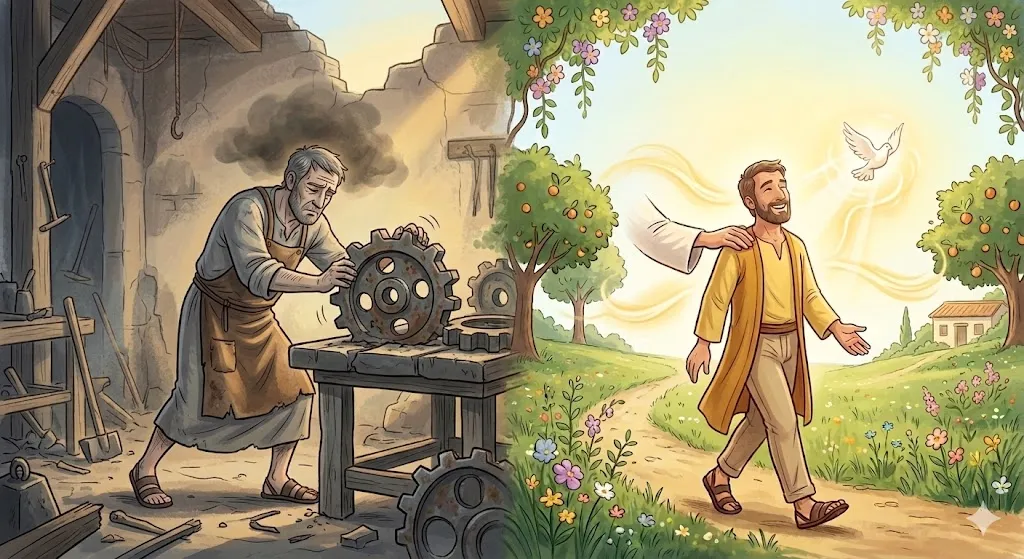
Have you ever tried to change a deep-seated habit, only to find yourself failing time and again? You know what you should do, yet you continue to do the very thing you want to stop. This internal conflict is a universal human experience, one that the Apostle Paul masterfully describes in the Bible. The core of this struggle reveals a profound spiritual truth: lasting, meaningful change doesn’t come from sheer willpower or external pressure. The truth is that God changes a person from the inside out.
This article explores the journey from human failure to divine empowerment, drawing timeless wisdom from the book of Romans. We will navigate the depths of Romans 7, which exposes the limitations of our own strength, and ascend into the freedom of Romans 8, which reveals the power of the Holy Spirit. If you feel stuck in a cycle of defeat and long for genuine transformation, understanding this shift is the key. We will uncover how to move beyond mere behavior modification and step into the life-altering reality that only God can provide.
The Agony of the Divided Self: Understanding Romans 7
Before we can appreciate the solution, we must first diagnose the problem. Romans chapter 7 serves as a powerful mirror, reflecting a state of inner turmoil that is familiar to anyone who has earnestly tried to live a righteous life. Paul, one of the most influential figures in Christian history, becomes incredibly vulnerable, admitting to a profound struggle.
He writes, “For I do not understand my own actions. For I do not do what I want, but I do the very thing I hate” (Romans 7:15). This isn’t the confession of someone who is ambivalent about right and wrong; it’s the cry of a person who loves God’s law but finds himself incapable of consistently obeying it.
The Law Reveals the Problem but Cannot Fix It
A common misconception is that if we just have enough rules, guidelines, and information, we will naturally do the right thing. We believe that more instruction leads to better behavior. Paul dismantles this idea. He explains that the law is “holy and righteous and good,” yet it has an unintended effect on our fallen human nature, which he calls “the flesh.”
- The Law as a Magnifying Glass: The law exposes sin for what it is. Before a rule exists, a person may not even recognize their action as a transgression. Paul says, “If it had not been for the law, I would not have known sin” (Romans 7:7). The law defines the boundaries.
- The Law and Rebellion: Paradoxically, the very presence of a command can awaken a desire to rebel. Paul notes, “Sin, seizing an opportunity through the commandment, produced in me all kinds of covetousness” (Romans 7:8). Think of a sign that says, “Wet Paint, Do Not Touch.” The warning itself can create an almost irresistible urge to see if the paint is truly wet. The issue isn’t the sign; it’s our nature.
This principle shows why simply telling someone, “Stop doing that!” or applying more social and religious pressure often fails. It might control outward behavior for a time, but it doesn’t change the heart’s desire. Pressure exposes the problem; it doesn’t provide the power for change. This is a critical reason why we must understand that God changes a person, not our rules or systems of control.
The Cry for a Rescuer
Paul’s internal battle leads him to a point of desperation. He recognizes that he is captive to a power greater than his own willpower. He cries out, “Wretched man that I am! Who will deliver me from this body of death?” (Romans 7:24).
This is the most important question in the chapter. Notice he doesn’t ask, “What new technique can I learn?” or “How can I try harder?” He asks, “Who will deliver me?” He understands the solution is not a new strategy but a Person. His problem requires a rescuer, not just a rulebook.
This desperate cry is the turning point. It’s the moment of surrender where we admit our own efforts have failed. It is only from this place of humility that we can truly appreciate the answer he gives in the very next verse: “Thanks be to God through Jesus Christ our Lord!” (Romans 7:25).
The Spirit of Life: How God Changes a Person in Romans 8
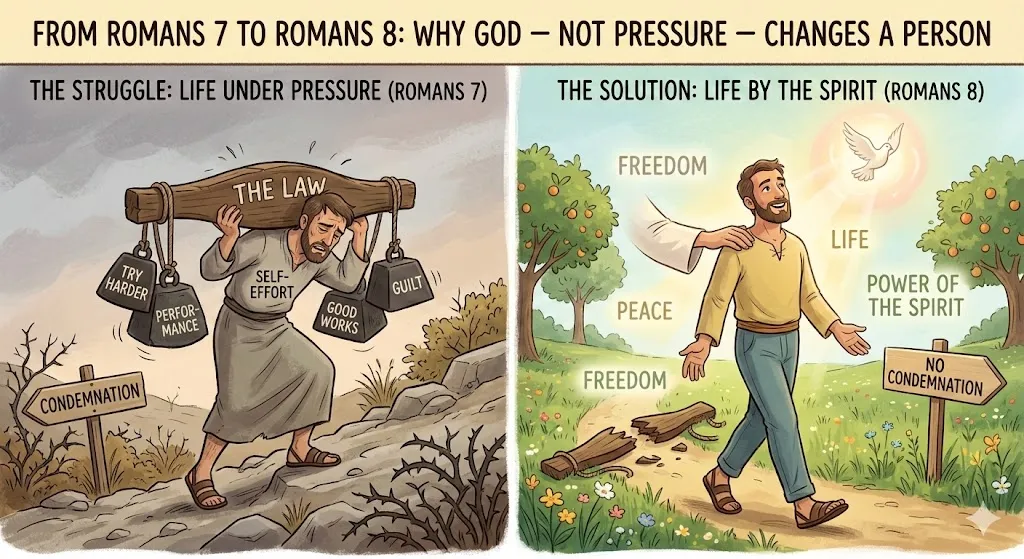
If Romans 7 is the diagnosis of our spiritual condition, Romans 8 is the divine prescription. It’s a chapter filled with hope, freedom, and power. It shifts the focus from our struggle to God’s solution, introducing the central role of the Holy Spirit in our transformation. The declaration that God changes a person becomes a lived reality here.
The chapter opens with one of the most powerful and liberating statements in all of Scripture: “There is therefore now no condemnation for those who are in Christ Jesus” (Romans 8:1). This is the foundation for all true change. Transformation does not begin with shame, guilt, or fear; it begins with the assurance of God’s complete acceptance and forgiveness through Christ. Condemnation paralyzes, but grace empowers.
The Law of the Spirit vs. The Law of Sin and Death
Paul explains the mechanics of this new life. He contrasts two operating principles: “the law of sin and death” and “the law of the Spirit of life.”
| Operating Principle | The Law of Sin and Death (Romans 7) | The Law of the Spirit of Life (Romans 8) |
|---|---|---|
| Source of Power | The flesh; human willpower | The indwelling Holy Spirit |
| Relationship to God’s Law | Sees it as an external demand; leads to failure and guilt | Fulfills the “righteous requirement of the law” from within |
| Mindset | “Set on the things of the flesh,” which is hostile to God | “Set on the things of the Spirit,” which leads to life and peace |
| Ultimate Outcome | Death; separation from God | Life and peace; adoption as God’s children |
The shift from Romans 7 to Romans 8 is the shift from trying to live for God in our own strength to allowing God’s Spirit to live through us. Paul makes it clear: “For God has done what the law, weakened by the flesh, could not do” (Romans 8:3). God didn’t just give us a better set of instructions; He intervened personally by sending His Son and giving us His Spirit. This divine intervention is how God changes a person at the deepest level.
Living by the Spirit: A New Way of Thinking
So, what does it mean to “live according to the Spirit”? It’s not about achieving a state of mystical perfection. It is a conscious, daily choice to set our minds on what the Spirit desires.
Paul says, “Those who live according to the flesh set their minds on the things of the flesh, but those who live according to the Spirit set their minds on the things of the Spirit” (Romans 8:5).
This highlights that the primary battleground for spiritual transformation is the mind. Change doesn’t start with behavior; it starts with belief and focus. Setting our minds on the Spirit involves:
- Prayer: Consistently communicating with God, aligning our thoughts with His.
- Scripture: Filling our minds with God’s truth, rather than the narratives of the world or the lies of the enemy.
- Worship: Shifting our focus from our problems to God’s greatness.
- Fellowship: Surrounding ourselves with other believers who encourage us to live for Christ.
This isn’t a passive process. Paul instructs, “If by the Spirit you put to death the deeds of the body, you will live” (Romans 8:13). Notice the partnership: you put to death the deeds, but you do it by the Spirit. Our role is to actively cooperate with the power the Holy Spirit provides. We are not powerless, but our power comes from Him.
Practical Implications: How This Truth Shapes Our Lives and Relationships
Understanding that God changes a person has profound, real-world consequences for how we view ourselves and how we interact with others. It frees us from the burden of being the agent of change and allows us to trust in God’s sovereign work.
Freedom from the Pressure to Perform
When we believe our acceptance by God depends on our performance, we live in a constant state of anxiety. Every mistake feels like a catastrophic failure. But the truth of Romans 8 frees us from this.
- You are accepted: Your identity is “in Christ Jesus,” where there is no condemnation. Your worth is not based on your ability to overcome a habit, but on Christ’s finished work on the cross.
- Progress over perfection: The spiritual life is a journey, not a destination. God is patient with our process. The Spirit’s work is often gradual, like a seed growing into a tree.
- Focus on relationship, not rules: True Christianity is a relationship with a person-Jesus Christ. When we focus on knowing Him, loving Him, and enjoying Him, obedience becomes a natural byproduct of that love, not a begrudging duty.
How We Approach Others Who Need Change
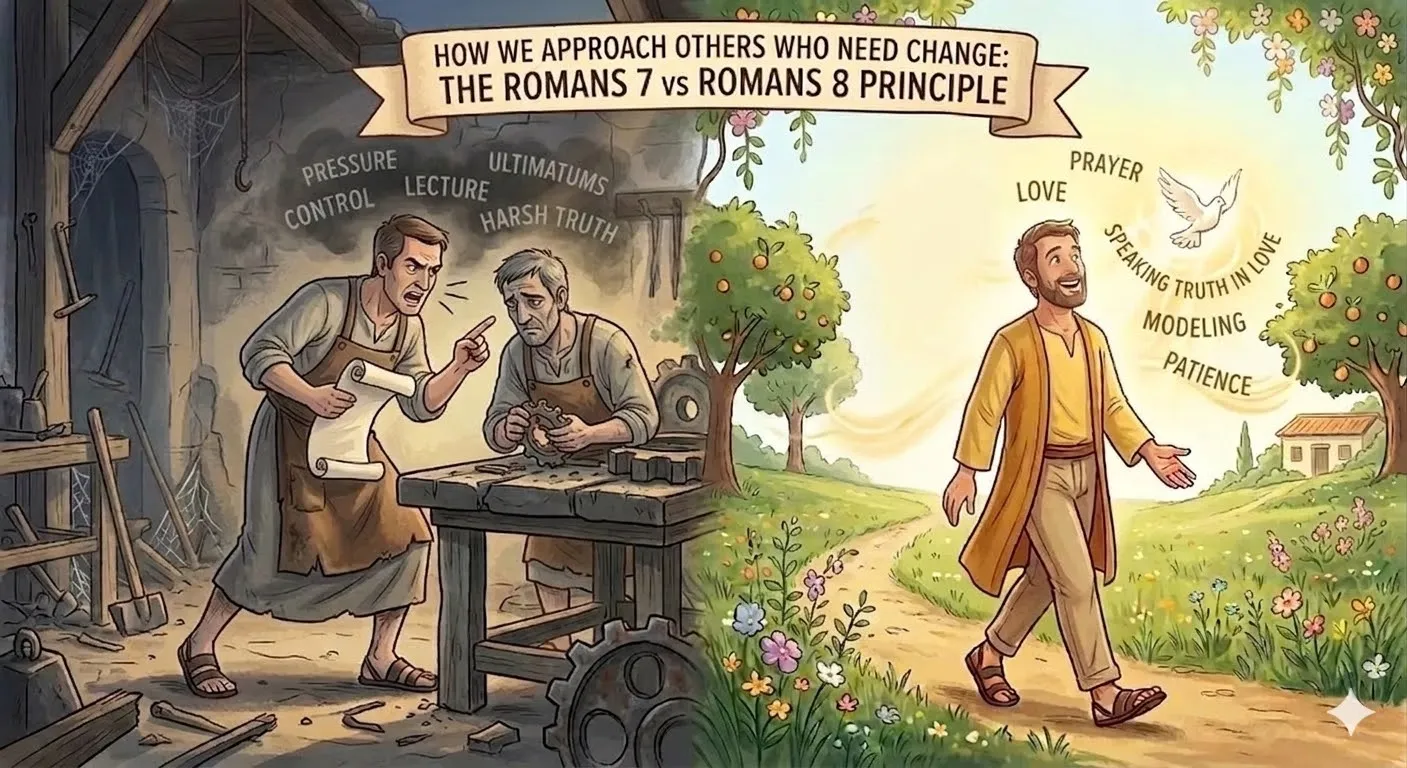
This principle radically alters how we try to help others. So often, when we see a friend, family member, or fellow church member struggling, our first instinct is to operate out of Romans 7-by applying pressure.
We might:
- Confront with harsh truth.
- Lecture or argue.
- Implement rules or ultimatums.
- Try to control their behavior.
While our intentions may be good, these methods are “weakened by the flesh.” They often produce more rebellion and resentment, not true repentance. A Romans 8 approach, however, looks very different. It acknowledges that only God changes a person.
Our role shifts from being the “fixer” to being a faithful instrument in God’s hands. This involves:
- Prayer: This is our primary work. We intercede for the person, asking the Holy Spirit to do what we cannot: convict, enlighten, and transform their heart.
- Love: We create an environment of grace, not condemnation. People are more likely to be open to change when they feel safe and loved, not judged and shamed.
- Speaking Truth in Love: We do not avoid hard conversations, but our motive and tone are different. We speak truth humbly, as fellow strugglers who are also dependent on God’s grace. (See Ephesians 4:15).
- Modeling: We live out the transformed life ourselves. A life changed by God’s Spirit is a more powerful testimony than any argument we could ever make.
- Patience: We trust God’s timing. Transformation rarely happens overnight. We must be willing to walk with people through a long and messy process, trusting that God is at work even when we can’t see it.
This approach requires us to surrender our desire for control and place our trust firmly in the sovereignty of God. As Paul wrote elsewhere, “So neither he who plants nor he who waters is anything, but only God who gives the growth” (1 Corinthians 3:7).
Trusting the Process: God’s Unseen Work
One of the hardest parts of this journey is trusting what we cannot see. Human change is often messy and non-linear. There will be good days and bad days, steps forward and steps back. In these moments, we must anchor ourselves in the promises of God.
Romans 8 is filled with assurances of God’s unwavering commitment to His children:
- He works all things for good: “And we know that for those who love God all things work together for good, for those who are called according to his purpose” (Romans 8:28). This includes our struggles and failures. God can use even our Romans 7 experiences to lead us to a deeper dependence on Him.
- He will complete the work He started: “For those whom he foreknew he also predestined to be conformed to the image of his Son…” (Romans 8:29). God’s ultimate goal is to make us like Jesus, and He will not stop until that work is complete.
- Nothing can separate us from His love: The chapter culminates in a triumphant declaration that nothing-no trouble, no hardship, no failure, no spiritual force “will be able to separate us from the love of God in Christ Jesus our Lord” (Romans 8:39).
This is our ultimate security. The process of change is not dependent on the firmness of our grip on God, but on the firmness of His grip on us.
Frequently Asked Questions (FAQ)
If only God changes a person, does that mean I have no responsibility?
Not at all. Our responsibility is to respond to and cooperate with the Holy Spirit. Paul says, “walk by the Spirit” (Galatians 5:16) and “put to death the deeds of the body by the Spirit” (Romans 8:13). This is an active partnership. God provides the power, but we must make the daily choices to align our minds and actions with Him. Think of it like a sailboat: the wind (the Spirit) provides the power, but the sailor must still hoist the sails and steer the rudder.
I’ve been a Christian for years and still struggle with the same sin. Does this mean God isn’t changing me?
Struggle is not a sign of God’s absence; it is often a sign of a spiritual battle being waged. The fact that you are fighting and feel the tension between your desires and God’s will (the Romans 7 experience) shows that the Spirit is at work within you. A person without the Spirit feels no such conflict. Be patient with the process. Lasting change is often slow and gradual. Continue to surrender that area to God, set your mind on the Spirit, and trust His promise to complete the work He began in you.
How can I help a loved one who is stuck in destructive behavior without enabling them?
This requires great wisdom and is a key area where the Romans 8 principle applies. You should speak the truth in love, establish healthy boundaries to protect yourself and avoid enabling their behavior, and refuse to “fix” problems that are the natural consequences of their actions. However, your primary posture should be one of prayer and love, always pointing them to their need for God. Your role is not to be their savior, but to point them to the only one who is-Jesus Christ.
Can a person be changed by God without them knowing it?
While the most dramatic transformations often involve a conscious crisis and surrender, the Spirit’s work is sometimes subtle. God can work through circumstances, conversations, and the quiet conviction of the heart over a long period. However, for the full freedom of Romans 8 to be experienced, there must be a conscious faith in Jesus Christ and a desire to live by the Spirit. The core of the gospel message is a call to “repent and believe,” which are conscious actions.
What’s the difference between behavior modification and true spiritual transformation?
Behavior modification is changing your actions, often through willpower or external incentives. You might stop a bad habit out of fear of consequences or desire for a reward. It is an outside-in approach. Spiritual transformation, as described in Romans, is an inside-out process. God changes a person’s heart and desires through the Holy Spirit. The change in behavior is then a fruit of the internal change, not the root of it. True transformation results in not just doing different things, but wanting different things.