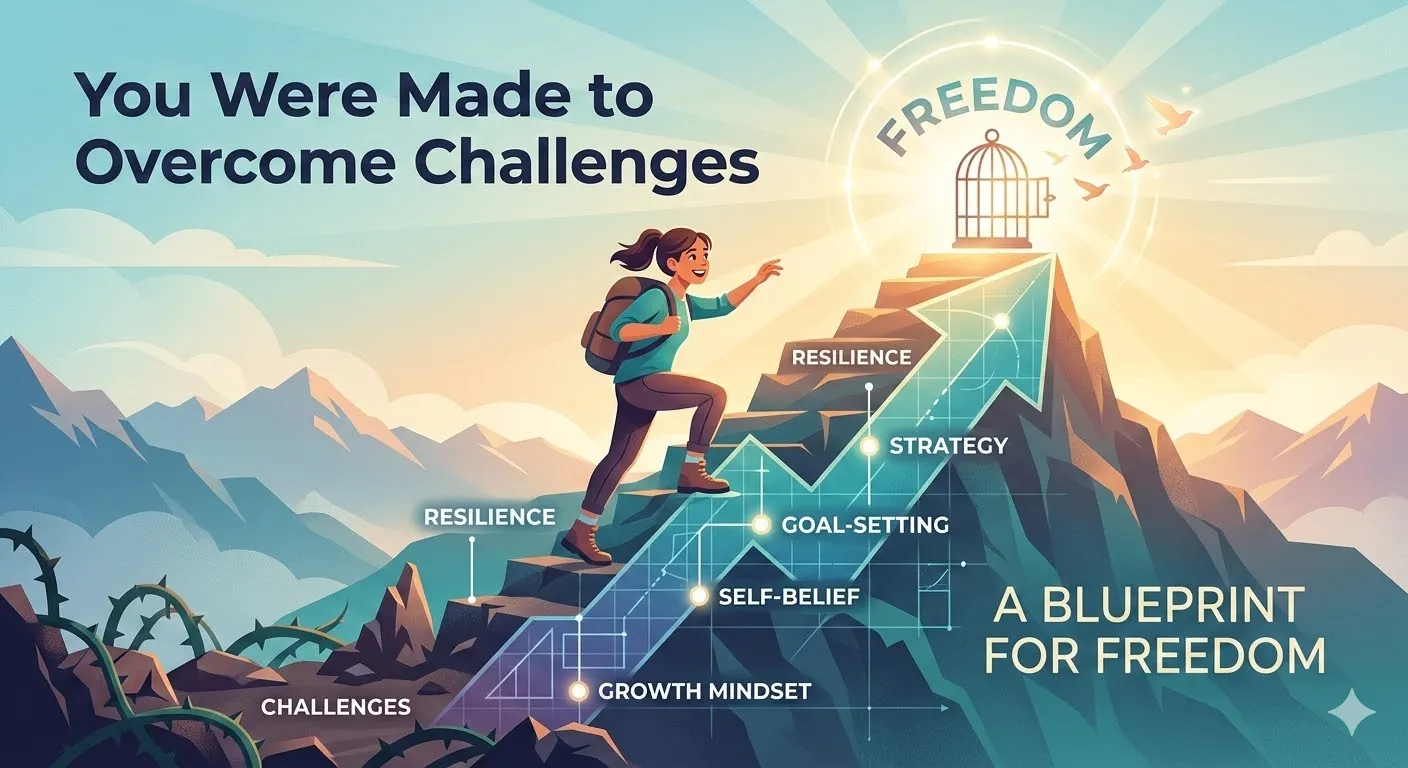
Life is filled with moments that test our limits. We all face personal struggles, setbacks, and temptations that can feel overwhelming. It’s easy to get stuck in a cycle of defeat, believing that this is simply our reality. But what if you were designed for something more? What if you were made to overcome challenges, not just endure them?
This is not about wishful thinking. It’s about understanding the deep-seated power you possess to break free from bondage and walk into a life of victory. Many people feel trapped by their past mistakes, addictions, or persistent negative patterns. They try to manage their behavior through sheer willpower, only to find themselves back where they started. True and lasting change, however, comes from a much deeper place. It comes from healing the soul.
This comprehensive guide will provide you with a blueprint to do just that. We will explore the root causes of persistent struggles, the psychological and spiritual dynamics at play, and actionable strategies to help you overcome challenges. You will learn how to shift your identity, heal from past wounds, and tap into a strength greater than your own to achieve lasting transformation. This is your path to not just managing your life, but mastering it.
The Myth of “Managing” Sin: Why Willpower Isn’t Enough
For many, the battle against a persistent habit or sin feels like a lonely war fought on the battlefield of willpower. We promise ourselves, “This is the last time,” only to fall again. This cycle often leads to shame, frustration, and a sense of hopelessness. Some may even receive well-meaning but misguided advice, suggesting that this struggle is just their “thorn in the flesh”, a cross they are meant to bear indefinitely.
This idea of simply managing sin is one of the most disempowering beliefs one can adopt. It suggests a life of containment rather than conquest. But true freedom doesn’t come from building better cages; it comes from dismantling the prison altogether.
The Limits of Behavior Modification
Behavior modification techniques focus on changing actions through external controls or sheer force of will. While these methods can offer temporary relief, they often fail to address the underlying drivers of the behavior. Think of it like mowing over weeds in a garden. You might clear the surface for a while, but if the roots remain, the weeds will inevitably grow back.
Persistent struggles, whether with addiction, anger, lust, or anxiety, are often symptoms of deeper issues. These are the “roots” buried in the soil of our souls:
- Unhealed Wounds: Past trauma, rejection, or abandonment can create deep-seated pain that we try to numb through destructive behaviors.
- False Beliefs: Lies we believe about ourselves, God, or the world can shape our reality and keep us trapped. Beliefs like “I’m not good enough” or “I’ll never change” become self-fulfilling prophecies.
- Emotional Triggers: Boredom, stress, loneliness, and shame can act as powerful triggers that push us toward old coping mechanisms.
- Spiritual Strongholds: These are deeply ingrained patterns of thought and behavior that give the enemy a foothold in our lives, creating a cycle that feels impossible to break.
Trying to overcome challenges with willpower alone is like trying to hold a beach ball underwater. It requires constant effort, and the moment you lose focus, the ball shoots back to the surface. It’s an exhausting and ultimately unsustainable way to live.
The Path to Victory: How to Truly Overcome Challenges
If willpower isn’t the answer, what is? The key lies in shifting our focus from behavior management to soul healing. When we allow God to access the deepest parts of our hearts, He can begin the work of uprooting the very things that cause destructive fruit in our lives. This is the path to genuine transformation and the ability to overcome challenges for good.
1. Identify the Roots, Not Just the Fruit
The first step is to ask the right questions. Instead of just asking, “How can I stop this behavior?” start asking, “Why am I drawn to this behavior?” This requires courage and honesty. Invite the Holy Spirit to reveal the underlying needs, wounds, or lies that your struggle is trying to meet or medicate.
Consider journaling or speaking with a trusted mentor or counselor to explore these questions:
- When does this temptation feel strongest? What emotions are present? (e.g., loneliness, stress, boredom, shame)
- What pain from my past have I never fully dealt with?
- Are there people I need to forgive? (Including myself?)
- What lies do I believe about my identity or my worth?
This process of introspection is not about dwelling on the past but about disarming its power over your present. As you identify the roots, you can begin to address them directly.
2. Embrace Your True Identity in Christ
One of the most powerful lies that keeps people in bondage is a case of mistaken identity. When you repeatedly fall, it’s easy to start believing, “I am an addict,” “I am a failure,” or “I am defined by my sin.” This is a lie from the enemy, designed to keep you powerless.
Your identity is not found in your struggles; it is found in Christ. If you have given your life to Jesus, the Bible declares a new reality over you:
- You are a new creation (2 Corinthians 5:17). The old has gone, the new has come.
- You are redeemed and forgiven (Ephesians 1:7). Your sins are washed away.
- You are a temple of the Holy Spirit (1 Corinthians 6:19). The power of God resides in you.
- You are a child of God (John 1:12). You belong to a heavenly Father who loves you unconditionally.
To overcome challenges, you must consciously reject the labels of your past and embrace the truth of who you are now. Meditate on these scriptures. Speak them out loud over yourself daily. The more you renew your mind with the truth of your identity, the less power the old identity will have.
3. Leverage the Power of the Holy Spirit
You were never meant to fight this battle alone. Romans 8:11 contains a staggering promise: “And if the Spirit of him who raised Jesus from the dead is living in you, he who raised Christ from the dead will also give life to your mortal bodies because of his Spirit who lives in you.”
The same resurrection power that conquered death itself now lives inside you. This is not a metaphor; it is a spiritual reality. When temptation arises, you don’t have to rely on your own limited strength. You can tap into the limitless power of the Holy Spirit.
How to do this practically:
- Acknowledge His Presence: In the moment of temptation, simply pause and say, “Holy Spirit, I need your help. I cannot do this on my own.”
- Surrender Your Will: Instead of fighting the desire, surrender it to God. “Lord, I give you this feeling, this urge. I choose your will over my own.”
- Ask for Strength: “Please give me the strength to walk away and the wisdom to choose the escape route You have provided.”
This act of surrender is not weakness; it is the ultimate act of strength, as it connects you to the source of all power.
Practical Strategies to Overcome Challenges in Daily Life
While soul healing is the foundation, there are also practical steps you can take to create an environment that supports your freedom. God provides the power, but He often calls us to partner with Him by taking wise and decisive action.
Building Your Spiritual Arsenal
Just as a soldier prepares for battle, you must prepare for the spiritual challenges you will face. Here are some essential disciplines.
| Spiritual Discipline | Description | Practical Application |
|---|---|---|
| Prayer | Direct communication with God. It’s your lifeline for strength, wisdom, and guidance. | Schedule specific times for prayer daily. Pray “in the moment” when temptation strikes. |
| Reading the Word | The Bible is your “sword of the Spirit” (Ephesians 6:17). It renews your mind and equips you with truth. | Read a chapter of Proverbs daily for wisdom and a chapter of the Gospels to keep your eyes on Jesus. |
| Worship | Worship shifts your focus from your problem to God’s power. It creates an atmosphere where the enemy cannot thrive. | Create a worship playlist for your car or home. When you feel down or tempted, turn on worship music. |
| Fasting | Denying the flesh to heighten your spiritual sensitivity. It helps break the power of physical appetites. | Start with a simple fast, such as skipping one meal or fasting from social media for a day to focus on God. |
Creating a Supportive Environment
Your environment can either fuel your struggles or foster your freedom. It’s crucial to be intentional about what and who you allow into your life.
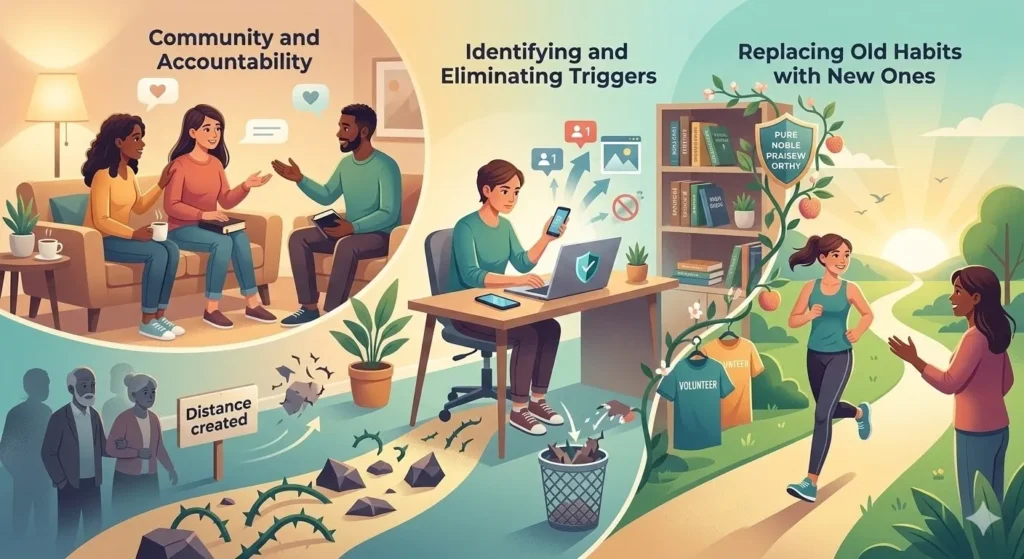
1. Community and Accountability:
Isolation is a breeding ground for sin. The enemy wants you alone with your secrets. Find trusted, mature believers you can be completely honest with. An accountability partner isn’t someone who shames you when you fall but someone who reminds you of the truth, prays for you, and helps you get back up. Consider joining a small group or a ministry like Celebrate Recovery.
2. Identifying and Eliminating Triggers:
Every struggle has triggers, people, places, things, or even times of day that make you more vulnerable. You must be ruthless in identifying and removing them.
- Digital Triggers: Do you need to install filtering software on your devices? Unfollow certain accounts on social media? Set time limits on app usage?
- Relational Triggers: Are there certain friendships that consistently lead you into compromise? You may need to create distance.
- Environmental Triggers: Do you need to change your route home from work? Avoid certain places?
This is not about living in fear but about living in wisdom. 1 Corinthians 10:13 promises that God will always provide a “way out.” Sometimes, that way out is taking practical steps to avoid the temptation in the first place.
3. Replacing Old Habits with New Ones:
When you remove a negative habit, you create a void. If you don’t fill that void with something positive, the old habit will rush back in. This is the principle Jesus taught in Matthew 12:43-45 about the unclean spirit returning to an “unoccupied” house.
- If you struggle with lust, fill your mind with God’s Word and commit to serving your spouse or your church.
- If you struggle with laziness or boredom, start a new hobby, join a gym, or volunteer.
- If you struggle with anger, practice gratitude and mindfulness exercises.
Actively fill your life with things that are pure, noble, and praiseworthy (Philippians 4:8).
Jesus: The Blueprint for a Free Life
One of the most profound shifts in perspective comes when we stop seeing Jesus as just our Savior and start seeing Him as our example. He is the perfect model of what a human life, fully empowered by the Holy Spirit, looks like.
John 14:12 says, “Very truly I tell you, whoever believes in me will do the works I have been doing, and they will do even greater things than these, because I am going to the Father.” Jesus walked the earth as a man, facing temptation, weariness, and spiritual warfare, yet He never sinned. He did this through His perfect reliance on the Father and the power of the Holy Spirit, the same Spirit that now lives in you.
When you feel like you can’t overcome challenges:
- Look at Jesus: He faced temptation in the wilderness and overcame it with Scripture (Matthew 4:1-11).
- Look at Jesus: He lived a life of purpose, authority, and perfect obedience.
- Look at Jesus: He didn’t just forgive sinners; He transformed them, telling them to “go and sin no more” (John 8:11).
Jesus didn’t come to give you coping mechanisms. He came to give you a new life. He is not just the one who sets you free; He is the blueprint of what a free life looks like.
Frequently Asked Questions (FAQ)
Q1: What is the “thorn in the flesh” Paul talks about, and could it be a recurring sin?
A1: While we don’t know for certain what Paul’s “thorn” was, most biblical scholars believe it was a form of physical suffering or intense persecution, not a recurring sin. The Bible consistently calls us to crucify the flesh, put sin to death, and be holy as God is holy (1 Peter 1:16). Nowhere does Scripture endorse the idea of accepting ongoing sin as a permanent part of the Christian life. To overcome challenges related to sin is a core part of our walk with God.
Q2: I’ve prayed and tried everything, but I’m still struggling. What am I doing wrong?
A2: You are not necessarily “doing anything wrong.” Healing and freedom are often a process, not a one-time event. Keep persevering in the strategies outlined above. It may be beneficial to seek professional Christian counseling to help uncover deeper roots that you may not be able to see on your own. Remember that God’s timing is perfect, and your perseverance is building endurance and character.
Q3: How do I find a good accountability partner?
A3: Look for someone who is spiritually mature, trustworthy, and of the same gender. It should be someone you respect and who is not afraid to speak the truth in love. The goal is not just to confess sin but to share your goals, struggles, and victories, and to pray for one another. Your church pastor or a small group leader can often help connect you with a suitable partner.
Q4: Is it possible to be completely free from temptation?
A4: As long as we live in this fallen world, we will face temptation. Jesus Himself was tempted. However, there is a major difference between being tempted and being enslaved. As you heal and grow stronger in your identity in Christ, the power of temptation diminishes. Things that once held a powerful grip on you will lose their appeal. Freedom isn’t the absence of temptation; it’s the power to consistently choose righteousness.
Q5: What if I fall again after making progress?
A5: A stumble is not the end of the journey. The enemy wants you to believe that one fall erases all your progress and that you’re back at square one. This is a lie. 1 John 1:9 says, “If we confess our sins, he is faithful and just and will forgive us our sins and purify us from all unrighteousness.” Get back up, confess your sin immediately, remind yourself of your identity in Christ, and learn from the mistake. What was the trigger? What can you do differently next time? Every stumble can be a lesson that ultimately makes you stronger.
You were not made for bondage. You are not your mistake, your past, or your addiction. You are a child of the Most High God, redeemed by the blood of Jesus and filled with the same Spirit that raised Him from the dead. You were made for victory. You were made to overcome challenges. Embrace this truth, walk in it, and watch as the chains begin to fall. Your freedom is not just a possibility; it is your inheritance.