
We often seek breakthroughs in our spiritual lives through fervent prayer, bold declarations, and acts of faith. Yet, sometimes, the results we long for remain just out of reach. This gap between our efforts and the outcome can leave us questioning everything. Is the timing wrong? Is it God’s will? Or is there an internal barrier we haven’t addressed? The answer might lie in a spiritual discipline that both sharpens our focus and purifies our faith: fasting.
In the biblical account found in Mark chapter 9, Jesus’ disciples faced a frustrating failure. They were unable to cast a demon out of a young boy, despite their best efforts. When they later asked Jesus privately why they had failed, His answer was profound: “This kind can come out by nothing but prayer and fasting” (Mark 9:29, NKJV). For centuries, this has been interpreted as a reference to a specific class of powerful demonic entities. However, a deeper look at the context reveals a more personal challenge. Jesus wasn’t just talking about the kind of demon; He was highlighting the kind of unbelief that hindered His own followers. The practice of intentional fasting breaks the power of unbelief, transforming our inner landscape so we can fully receive and walk in divine power.
This article will explore the deep connection between fasting and faith. We will examine how this ancient practice dismantles the internal strongholds of doubt, aligns our hearts with God’s will, and unlocks new levels of spiritual growth. You will learn not just the “why” but also the “how,” gaining practical steps to incorporate this powerful discipline into your life.
Unpacking the Link: Why Jesus Connected Fasting to Unbelief
To truly understand how fasting breaks the power of unbelief, we must go back to the scene of the disciples’ failure. Before mentioning prayer and fasting, Jesus first addressed the root issue: their lack of faith. In Matthew’s account of the same event, He says, “Because of your unbelief; for assuredly, I say to you, if you have faith as a mustard seed, you will say to this mountain, ‘Move from here to there,’ and it will move; and nothing will be impossible for you” (Matthew 17:20). He then adds, “However, this kind does not go out except by prayer and fasting” (Matthew 17:21).
The sequence is crucial. The primary obstacle was unbelief. Fasting was presented as the solution to that very obstacle. It wasn’t about a super-demon that required a special spiritual weapon. It was about a deeply rooted doubt in the disciples that weakened their spiritual authority.
The Cry of a Desperate Father: “Help My Unbelief!”
The boy’s father provides a powerful and relatable picture of this internal conflict. When Jesus told him that all things are possible for one who believes, the man cried out, “Lord, I believe; help my unbelief!” (Mark 9:24).
This single statement captures the tension so many of us experience. We have a genuine desire to trust God, and we intellectually assent to His power. Yet, in the hidden corners of our hearts, doubt, fear, and human reasoning wage a constant war against our faith. We are, as the apostle James describes, “double-minded.”
James 1:6-8 paints a stark picture of this condition:
“But let him ask in faith, with no doubting, for the one who doubts is like a wave of the sea that is driven and tossed by the wind. For let not that man suppose that he will receive anything from the Lord; he is a double-minded man, unstable in all his ways.”
This isn’t a condemnation but a diagnosis. Doubt acts as static, interfering with the signal of faith. Fasting is the process that helps clear that static.
What is Unbelief, Really?
Unbelief isn’t simply the absence of faith. It’s an active force rooted in our flesh, our past experiences, and our reliance on what we can see, touch, and understand.
- Reliance on the Senses: Unbelief trusts what the five senses report more than what the Word of God declares.
- Rooted in Fear: It often stems from a fear of disappointment, a fear of looking foolish, or a fear of what might happen if God doesn’t come through.
- Fueled by Comfort: Our desire for physical comfort and the satisfaction of our appetites keeps our flesh in a dominant position, drowning out the voice of our spirit.
Understanding this is key to seeing why fasting breaks the power of unbelief. It directly confronts these pillars of doubt.
The Spiritual Mechanics: How Fasting Breaks the Power of Unbelief
Fasting is not a spiritual hunger strike designed to twist God’s arm or persuade Him to act. God is already willing and able. Fasting is a discipline for our benefit; it changes us, not Him. It creates an internal environment where faith can flourish by systematically weakening the things that feed our unbelief.
1. It Subdues the Flesh and Elevates the Spirit
Our bodies have strong appetites, for food, comfort, entertainment, and validation. When these appetites rule us, our spiritual senses become dull. The “flesh” in a biblical sense refers to this self-centered, worldly nature that is naturally opposed to the things of God.
Prayer and fasting directly challenge the dominance of the flesh. When you voluntarily deny your body’s craving for food, you are making a powerful declaration: “My spirit, not my stomach, is in charge.” Each pang of hunger becomes a reminder to turn your attention toward God.
This act of intentional denial does several things:
- It Weakens Cravings: You prove to yourself that you are not a slave to your physical urges. This discipline extends beyond food to other areas where the flesh seeks control.
- It Increases Sensitivity: As the roar of your physical appetites subsides, you become more sensitive to the gentle whisper of the Holy Spirit.
- It Reorders Your Priorities: Fasting forces you to find sustenance from a different source, God Himself. It clarifies what is truly essential.
By subduing the flesh, you dismantle one of the primary sources of doubt and create space for your spirit to agree with God, which is the very essence of faith.
2. It Detoxifies the Soul from Doubt and Fear
Just as our bodies can accumulate toxins from an unhealthy diet, our souls can accumulate the toxic residue of fear, worry, anxiety, and cynicism. These are the ingredients of unbelief. We are constantly bombarded with messages of fear from the world, negative reports, and our own past failures.
Fasting acts as a spiritual detox. It is a dedicated time to unplug from the constant stream of worldly input and plug directly into the divine source. By replacing meal times with times of prayer, meditation on Scripture, and worship, you actively flush out the toxins of doubt and replace them with the truth of God’s Word.
Think of it this way:
| Input Source | Feeds Unbelief | Feeds Faith |
|---|---|---|
| Worldly Media | News reports of chaos, cynical entertainment, advertisements promoting dissatisfaction. | |
| Past Failures | Replaying memories of prayers that seemed unanswered, focusing on personal weaknesses. | |
| Human Reasoning | Relying solely on logic and what seems “possible” or “practical.” | |
| God’s Word | Promises of His faithfulness, power, and love. | |
| Prayer & Worship | Direct communion with God, realignment of perspective. | |
| Holy Spirit | Inner witness of truth, peace that surpasses understanding. |
Fasting intentionally starves the sources that feed unbelief and force-feeds your soul with what builds authentic faith. This is a critical way fasting breaks the power of unbelief.
3. It Sharpens Your Spiritual Focus and Clarity
In our busy lives, our attention is constantly fragmented. We multitask, scroll through endless feeds, and are pulled in a dozen different directions at once. This mental clutter is hostile to the focused concentration that deep faith requires.
Fasting is a powerful tool for achieving mental and spiritual clarity. By simplifying your physical routine, you simplify your mental landscape. The time and energy normally spent on planning, preparing, and eating meals are redirected toward a single purpose: seeking God.
This sharpened focus allows you to:
- Hear God More Clearly: With less internal and external noise, His guidance becomes more distinct.
- Perceive Spiritual Realities: You become more aware of the spiritual battle around you and your position in it.
- Identify Hidden Strongholds: In the quietness of a fast, the Holy Spirit can reveal areas of hidden doubt or sin in your heart that you were previously unaware of.
Jesus, who was without sin and had perfect faith, still began His public ministry with a 40-day fast. He did this to step into His calling with absolute focus and clarity, fully reliant on the Spirit. If He needed it, how much more do we?
Practical Steps for Overcoming Unbelief Through Fasting
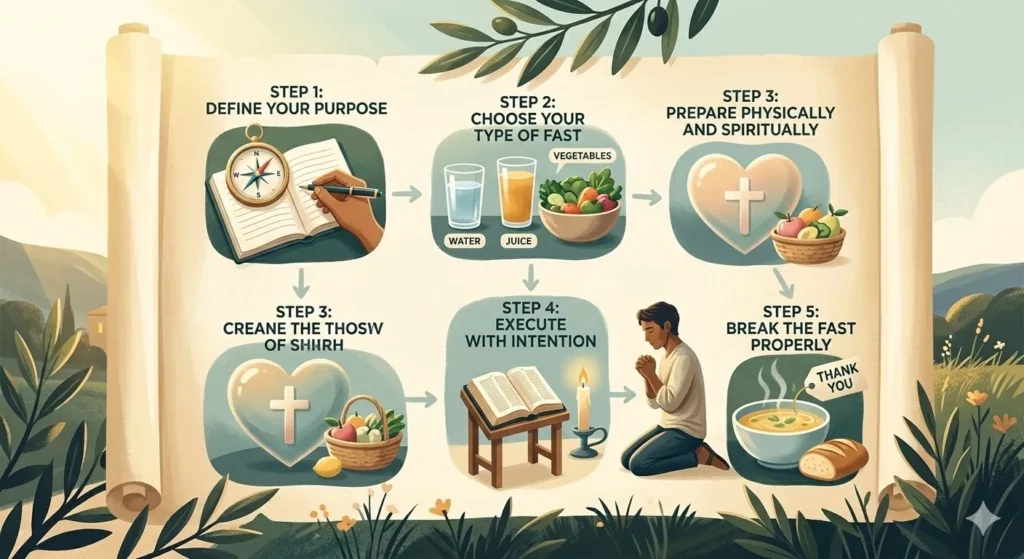
Embarking on a fast for the purpose of spiritual growth and overcoming unbelief requires intention and preparation. It’s more than just skipping a meal. Here is a practical guide to help you begin.
Step 1: Define Your Purpose
Before you begin, be specific about your goal. Why are you fasting? Are you seeking a breakthrough in a particular area? Do you want to address a specific fear or recurring doubt? Write it down. Your purpose will be your anchor when the fast becomes challenging. A clear objective helps you focus your prayers and measure your progress.
Example Objectives:
- To break a spirit of fear concerning my finances.
- To gain faith for the healing of a family member.
- To overcome a specific, habitual sin.
- To hear God’s direction for my career.
Step 2: Choose Your Type of Fast
There are many different ways to fast. Choose one that is appropriate for your health, your work schedule, and your level of experience. The goal is a meaningful sacrifice, not a health crisis.
Types of Fasts:
- Full Fast: Water only. This is typically for shorter durations (e.g., 24 hours) and should be done with caution, especially by those with medical conditions.
- Juice Fast: Consuming only fresh fruit and vegetable juices and water. This provides some nutrients while still denying solid food.
- Partial Fast (or Daniel Fast): Abstaining from specific types of food, such as meats, sweets, and processed foods, while eating vegetables, fruits, and whole grains. This is an excellent option for longer fasts.
- Intermittent Fast: Restricting your eating to a specific window of time each day (e.g., eating only between 12 PM and 6 PM).
- Media/Entertainment Fast: Abstaining from non-essential media like social media, television, or secular music to reduce distractions.
Step 3: Prepare Physically and Spiritually
Don’t jump into a long fast without preparation.
- Physical Prep: A few days before your fast, begin to eat smaller meals and reduce caffeine and sugar intake. This can help minimize initial side effects like headaches and irritability.
- Spiritual Prep: Dedicate time to pray and ask the Holy Spirit to guide your fasting period. Repent of any known sin to ensure your heart is prepared to hear from God. Inform your family or a trusted friend so they can support and pray for you.
Step 4: Execute with Intention
During the fast, be intentional about how you use your newfound time.
- Replace Meals with Prayer: Use the time you would normally spend eating to pray, worship, and read the Bible. Focus your prayers on your stated purpose.
- Keep a Journal: Write down what God is showing you. Document any scriptures, insights, or shifts in your perspective. This helps you track how fasting breaks the power of unbelief in your own heart.
- Stay Hydrated: Drink plenty of water throughout your fast, regardless of the type.
- Listen More Than You Speak: Fasting is a time to quiet your own voice and amplify God’s. Practice silent waiting and listening in His presence.
Step 5: Break the Fast Properly
How you end your fast is as important as how you begin. Do not immediately return to heavy, rich foods, especially after a longer fast.
- Start with small portions of easily digestible foods like soup, yogurt, or cooked vegetables.
- Gradually reintroduce other foods over a period of one or two days.
- Take time to reflect on your experience and thank God for what He has done.
Frequently Asked Questions (FAQ)
Here are answers to some common questions about this powerful spiritual discipline.
Q1: How long should I fast to see a breakthrough?
A: There is no magic formula for the duration. The length of your fast is between you and God. A one-day fast can be incredibly powerful if it is focused. Sometimes, a longer fast (3, 7, or even 21 days) is needed to break down deeply entrenched strongholds. The key is not the duration but the condition of your heart and your level of focus during the fast. Start with shorter fasts and gradually increase the length as you feel led.
Q2: Will I feel weak and unable to work or function?
A: You may experience some physical weakness, especially in the first few days as your body adjusts. However, many people report a renewed sense of mental clarity and spiritual strength that more than compensates for the physical lethargy. If you have a physically demanding job or health concerns, a partial fast or media fast may be a wiser choice. Always consult your doctor before beginning any new fasting regimen.
Q3: Isn’t fasting an outdated Old Testament practice?
A: While fasting was common in the Old Testament, Jesus Himself practiced it and taught on it in the New Testament (Matthew 6:16-18). He clearly expected His followers to fast, saying, “When you fast,” not “If you fast.” The early church also practiced prayer and fasting regularly (Acts 13:2-3, Acts 14:23). It is a timeless discipline for spiritual growth and deepening one’s relationship with God.
Q4: What if I fast and still don’t see results?
A: Fasting is about process, not just outcome. The primary work of fasting happens inside you. Perhaps the fast has revealed an even deeper layer of unbelief or a wrong motive you were unaware of. It might be the first step in a longer journey of overcoming unbelief. Remember, the fact that fasting breaks the power of unbelief means it’s a tool for ongoing transformation. Don’t be discouraged. Reflect on what you learned during the fast and consider what your next step of faith should be. The breakthrough is often in the change within you, which then positions you to receive the change you seek externally.
Q5: Can fasting give me more spiritual authority?
A: This is a subtle but important point. Your authority as a believer comes from your position in Christ, not from your works. Fasting doesn’t earn you more authority. Rather, it helps you walk in the authority you already possess. It does this by clearing away the hindrances, like fear, doubt, and fleshly desires, that prevent you from exercising that authority with confidence and faith. Fasting aligns you with your true identity and power in Him.
Your Next Step Toward Unshakeable Faith
The disciples stood powerless before a challenge not because God was unwilling, but because their own unbelief stood in the way. Jesus gave them the key: a path of disciplined self-denial that would recalibrate their hearts and restore their faith.
That same key is available to you today. If you feel stuck, if you’ve prayed and declared but still see no movement, consider this your invitation. It may be time to quiet the noise, subdue the flesh, and sharpen your spiritual senses. It may be time to discover for yourself how fasting breaks the power of unbelief.
This isn’t about earning God’s favor or manipulating a result. It’s about positioning your heart to receive what He has already promised. It’s about clearing the channel so His power can flow through you without obstruction. Start small, be intentional, and prepare to see the deepest change happen not in your circumstances, but within you. That is where true victory begins.